Alumna Leads IBM’s Internet and Social Business Marketing

I’m proud to be a Spartan! My college experience was unforgettable and propelled me to pursue my dreams of working in the Marketing & Communication profession. My Alma Mater Michigan State University, ran this nice feature to help promote my book The Most Powerful Brand on Earth: How to Transform Teams, Empower Employees, Integrate Partners and Mobilize Customers to Beat the Competition in Digital and Social Media. 

Read the full post: Alumna Leads IBM’s Internet and Social Business Marketing

Want to find brand ambassadors? Start with your employees

CMO of Branderati and author of Think Like ZuckEKaterina Walter explores the emerging employee advocacy movement in this post: Want to find brand ambassadors? Start with your employees where she cites my point of view that “in social media people – not brands – are the channel.” For more on the importance of building trust & credibility, how to support your employees to engage and drive brand advocacy, and how not to treat social media as just another channel, reference:  The Most Powerful Brand on Earth

Embracing challenge. Pioneering brand marketers pave the way to lead digital & social business at their companies

Greg Gerik @ggerik of 3M moderates a panel of pioneering brand marketers at the 3M Think Tank. Kevin Hunt (General Mills), Susan Emerick (IBM) and Mason Nelder (Verizon) openly discuss core challenges companies face when embracing digital & social.

Mason Nelder @MasonNelder cites “Closing the leadership knowledge gap” as a huge challenge and how “It’s on us to communicate and educate” and help drive change.  “We’re in a big incubator – fail fast, fail often — but learn from it and find incremental gains.  … We must keep the voice of the customer at every point of the product lifecycle.”

Kevin Hunt @kevin_hunt explains the talent gap. “There aren’t enough rubber bands and sticks of gum”, currently staff is stretched really thin and lack of funding is a challenge. There’s an expectation that people will where many hats. In the future, it’ll be a luxury that we’ll be able to have staff who are more well rounded, demonstrating higher levels of aptitude to support your company’s needs. “There are scores of new leaders on the horizon, soon a new landscape will be upon us.”

What is Nirvana? Susan Emerick @sfemerick shares that “social must become integrated into the way we work, a part of every aspect of the work we do, and gone are the days of silo’s. Soon, it will be integrated into Sales, Customer Service, HR, in addition to Marketing & Communications. …. We have a vast opportunity to expose the expertise of employees through Employee Advocacy.”

Seated left to right: Kevin Hunt, Susan Emerick, Mason Nelder and Greg Gerik

Touring the 3M Innovation Center was an amazing immersive experience. The space, set up with interactive demo stations, chronicled thousands of product discoveries, advancements and featured how each makes life better. Burgeoning with stories about the work passionate 3M employees do, all just waiting to be told.

A huge Thank You to Greg Gerik @ggerik of 3M and his team for organizing and hosting such a great event. I was honored to be included.


Customers Trust Expert Social Employees more than any other source

Employee Advocacy is getting a lot of hype lately. So what’s the secret to empowering social employees to be engaged in social media to benefit your brand? Here’s a short video from today’s 3M Think TANK, hosted by Greg Gerik where following Brian Solis, I present a few concepts from our new book The Most Powerful Brand on Earth: How to Transform Teams, Empower Employees, Integrate Partners, and Mobilize Customers to Beat the Competition in Digital and Social Media 

3M ThinkTANK, September 26, 2013 – Susan Emerick

For the full roadmap on how to mobilize expert employees to advocate for your brand, check out the book on Amazon

Two Surprising Keys to Build Trust and Drive Sales Through Social Media

In a world where information continues to explode, people still trust people. In fact, research from Edelman and Nielsen continue to show that people are more likely to trust information from an organization’s employee or from someone they perceive to be like themselves, than from an organization’s official communicators, web site or sponsored content.

If your content marketing plans do not include some level of empowering employees to publish in social media, you may be missing a huge opportunity to build trust with your audience.

This post Two Surprising Keys to Build Trust and Drive Sales Through Social Media by my co-author Chris Boudreaux, ran today on Social Media Today and will help you understand how to build trust and drive sales in Social Media. 

The Social Enterprise: Lessons on Content, Internal Advocacy and the Human Element

Today I chatted with BlogTalkRadio’s Kathy Klotz-Guest @kathyklotzguest about the employee advocacy strategy my team has been leading at IBM. We discuss how to contend with the need for content, how it’s not just about technology, and how to balance marketing as both art and science.

With many years of careful strategic planning and implementation, IBM now has more internal employee bloggers/champions than any company around. If you’re interesting in how IBM has been able to scale relationships by being open, decentralizing content creation and trusting (and empowering) passionate employees to carry the torch, you’ll want to take a listen: The Social Enterprise: Lessons on Content, Internal Advocacy and the Human Element

Are marketing departments prepared for big data?

I recently shared my thoughts on how marketing professionals are generally ill-prepared for leveraging the opportunities available for using data and analytics tools to gain deeper insights into customer behaviors and market trends. Here’s an excerpt from that discussion where I explain how B2B marketing leaders need to move beyond simply consuming data to using data in real-time and applying predictive analytics to better align the insights that are obtained with the strategic initiatives the organization is focused on. You can read further details in IBM’s Global CMO Study

Participating along with me on this panel were B2B marketing experts David Meerman Scott and Mark Wilson @Avaya. Thanks to veteran journalist Ellis Booker for moderating our discussion. View our Google Hangout discussion in full:  Top B2B Marketing Trends 2013

How to end a client relationship

This post is especially important for agency partners who are striving to build and maintain business with a client.  It’s written from my vantage point as the “client”, and summarizes my thoughts on ways to successfully end a client relationship, obviously a list of “what not to do”. Certainly each should be avoided if you intend to retain a client’s business.

Reflecting on 2012, I have a lot to be thankful for and proud of. However an experience I had during this year (unfortunately it wasn’t a good one) prompted this post. I wanted to be sure to capture these points because it’s my belief that from difficult situations, lessons can be learned if you’re willing to be open to debriefing, discussing and sharing to avoid repeating them in the future.

A bit of perspective, I spent several years in the beginning of my career on the agency side of the business. I’d like to think that having done so makes me a more reasonable client, one who knows and appreciates the in’s and out’s of agency operations and one who knows it’s critical for clients to provide clear direction. I always strive to be clear with requirements, limitations and overall direction throughout each initiative. I’m also deeply committed to delivering successful programs and believe that strong partnerships are key to that success.

How to end a client relationship:

  1. Have your agency’s goals for profitability outweigh your client’s objectives
  2. Lose sight of the fact that the client actually hired you, you didn’t hire the client.*
  3. Be unclear about your terms of service
  4. Bill for services not rendered
  5. Believe that the ideas you put forth in your engagement are in the end too valuable to allow your client to implement without changing the terms in your contract
  6. Not recognizing and respecting your client champions
  7. Creating issues your client champions have to escalate to their management, legal or procurement
  8. Not responding to client change requests swiftly and in a way that proves to your client that their goals are paramount and you will help them achieve them even if changes in scope are presented along the way
  9. Not providing change orders promptly when the scope of the project is adjusted
  10. Not adapting to new client players and understanding if a new client player is now a key decision maker for a component of the program overseen by the client champion
  11. Leaving your client without receiving what they expected to be delivered
  12. Not being clear about what will be delivered
  13. Not being clear about when delivery will happen
  14. Not recognizing that clients are influential too, they have relationships with other business units, other agency partners and industry associations which could be used as channels to express their dissatisfaction
  15. Not realizing that being difficult to work with out weighs the benefit and value of the work delivered, no matter how creative it may be

* Clients hire agencies on a “work for hire” contract or retainer basis. Clients document requirements & relationship terms of delivery in scope of requirements documents as well as base agreement which stipulate terms of the contract – work for hire.


I’d be interesting in knowing what you think and if you have other thoughts on this topic, please post your comments.


Trusted Experts engaged in social media are 135% more effective at generating leads

The Practice of Effective Social Business Program Management
Social gives you the ability to connect human beings with one another and ignite conversations around shared topics of interest relevant to your brands priorities. So if you’re thinking about social as just another channel to push content through, think again.

As you build your social program, identify insights and key learning’s from your listening research. Evaluate the ecosystem of people and connections.  Think through how you can create a presence that will appeal to those you want to build relationships with and who would be best suited to be the focal point. Most likely, it’s not a marketer. Rather, focus on encouraging dialogue with your employees who have expertise to share. These leaders will not only have valuable knowledge, they also hold the promise to become the most trusted and credible within a relationship.

Like any other tactic or channel, social should not be approached independently but with an eye towards fulfilling your larger objectives. As you begin to think about your social plan ask yourself what role it will play in achieving your overall goals? Defining and identifying realistic ways to measure success are critical steps in creating the framework for a successful program.

Another crucial element in the early stages of developing a social program is performing listening research – this is how you get to know your audience and come to understand where they like to spend their time online and what kinds of content and tactical approaches they are most likely to respond to.

A change Agent – The emerging role of the Social Business Manager
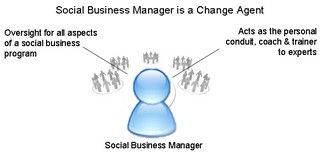
Social business management is undertaken by people who create and engage in social digital experiences on behalf of your brand. At IBM, there’s a new role emerging, the Social Business Manager. This individual not only collaborates closely with the extended marketing management team to provide oversight for all aspects of a social business program including social listening research, planning, engagement and measurement. They also act as a change agent.
They’re driving cultural change and adoption of social through their commitment to:

  • Work with employees as a relationship manager and coach
  • Provide direction to employees on relevant influencers, external brand champions, partners and competitors within specific topic area. Help employees establish priorities which relationships to focus on.
  • Provide supporting assets, program guidance, training and critical feedback to those employees engaged in social outreach

Through some early pilot work I’ve been leading, we’re able to quantify that engagement with influential experts in social media is 135%* more effective at generating sales leads than traditional digital marketing tactics. Another way of saying this is, trusted SMEs who share their expertise online are 7x more likely to drive initiations with a call to action (offer) when compared to other digital marketing tactics in the same period.

This is a win-win for the brand and employees. The employees benefit from building their professional reputation and increasing their visibility in their field, while they drive the brand’s influence and support lead development in the market.

If you’re approach social as just another channel for marketers to manage and push content through, think again.

*IBM Select Social Eminence pilot 3Q2012



Building the IBM Brand in the Social Sphere

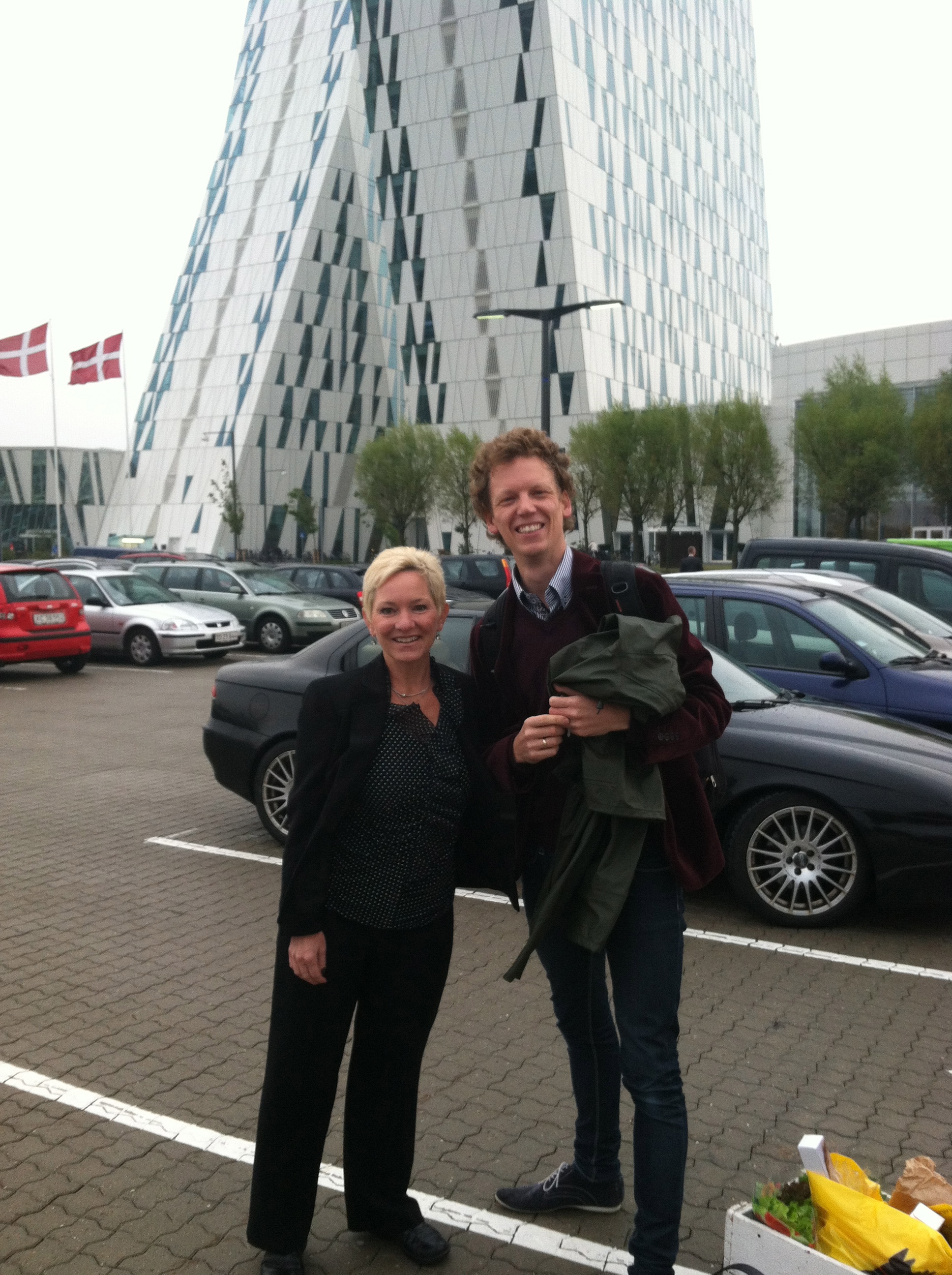
I’ve traveled to Copenhagen, Denmark to speak at the IBM Smarter Business Event.

This is my first time here and it’s an amazing vibrant city, full of old world charm and tourists from around the globe. I was lucky enough to have some time when I first arrived to tour a bit and take some snapshots to share with my family, friends and co-workers back in the US.

I’m excited to present work I’m leading, more specifically the IBM Select Social Eminence Program. This initiative empowers employees who are world-renowned for their expertise, experience, and reputation to more effectively share their knowledge across the social web. This is one of many social enterprise programs in IBM’s digital & social marketing strategy.

Also presenting is my esteemed colleague Christian Carlsson @chris_carlsson, IBM Digital Leader of Denmark. He’ll be sharing Social Business Recipes from IBM’s Social Business transformation.

While Christian and I have met virtually many times via collaborative communities and have shared ideas over the phone while web conferencing, there’s nothing like meeting in person face to face. 

I’m also looking forward to is talking with our IBM Customers who are keen to understand what IBM’s doing to become a social business. It’s a journey, one that I’m passionate about and have been involved with shaping for a number of years.

After that, I’ll lead a discussion with MBA students about the importance of building & sustaining your personal brand online. Share tips on getting started, how to make connections with those who share your interest and provide some recommendations on what not to do.

For those attending the event, I look forward to meeting you! For those following the event, I’ll share my perspectives via Twitter #sbdk #socbiz @sfemerick