
CMO of Branderati and author of Think Like Zuck, EKaterina Walter explores the emerging employee advocacy movement in this post: Want to find brand ambassadors? Start with your employees where she cites my point of view that “in social media people – not brands – are the channel.” For more on the importance of building trust & credibility, how to support your employees to engage and drive brand advocacy, and how not to treat social media as just another channel, reference: The Most Powerful Brand on Earth
Tag: Employee Advocacy
Work your core: Proven principals to drive Employee Advocacy results
This post provides a whole new meaning of “working your core”. These concepts will help you strengthen the results which your employees can drive by creating advocacy for your brand.
The target zone: Start small, be specific, choose wisely
Just like in a core body workout, seeing incremental results for the time and effort you put in, inspires you to keep with it. The same is true for building a employee* advocacy program for your brand. Start small, by choosing the best suited employees and partners, who will help you achieve and demonstrate incremental results more quickly. Be specific and choose wisely by applying the 1% rule (“90–9–1”) to your program recruiting. Focus on recruiting the best suited 1% of employees who have demonstrated they understand the value of building their reputation & are keen on increasing their visibility, committed to providing value to their network and sustain that commitment over time. Provided you’re conducting social listening, these select few are likely to naturally emerge in the social listening research as prominent and trusted experts in a topic that’s relevant to your business development goals. Use this intelligence wisely. Once you’ve prioritized this 1%, then set your sights on expanding to the 9%.
Consider establishing criteria which program participants must meet, here are a few examples I’ve found to be a winning recipe:
• A solid social footprint. Individuals that have worked to established a solid social footprint on their own and are focussed on participating actively in key social venues which are most relevant to the topic and/or network of interest.
• Accessible. Individuals who’ve proven to be natural collaborators and are comfortable with making themselves available to their network. They focus on responding & engaging in ways that provide value to their connections.
• Actions speak louder than words. Those that sustain engagement over time, are committed to sharing their expertise and helping others by demonstrating community leadership skills, drive superior results. They know well that it takes time, a commitment to consistency and engagement isn’t a hit-or-miss, occasional activity. They don’t just say they “get it”, they act on it. Engagement is a critical skill and is prioritized as an approach to the way they work.
Improve Reach: Focus on quality over quantity
At every stage of the customer experience, customers can talk about your brand within social media. As a result, you must nurture relationships in social media throughout the customer experience. Your employee advocates must be able to reach key target publics at each stage, get them engaged with your content, and motivate them to advocate on your behalf.
This is not easy to accomplish. It requires a focus, not just building a network for sheer volume, but rather building a quality network which shares common interest and benefits from the information your employees share. When your employee advocates nurture ongoing relationships with your audience in this way, they establish relationships with what we call a “social core”. The social core are simply people whom you reach, and have opted in to engage with you, and who would most likely advocate on your behalf.
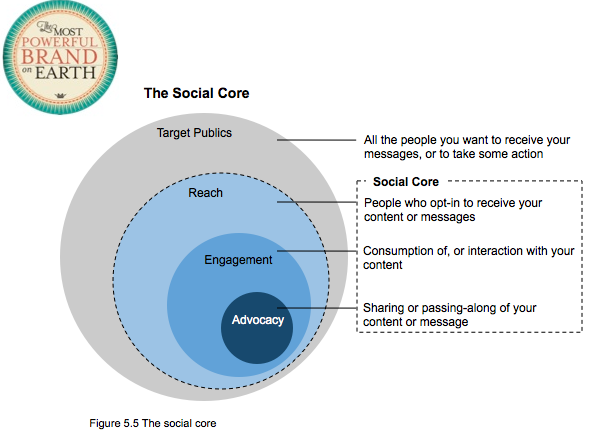
Ultimately, the social core becomes an asset of the brand. An asset that you should mobilize your employees to nurture and build over time. In addition, you should continually evaluate and measure the health and strength of your social core so that you can continually improve the degree to which you are making it stronger.
See more details on these concepts and frameworks in The Most Powerful Brand on Earth – Chapter 5: You’ll measure new things in new ways
Embracing challenge. Pioneering brand marketers pave the way to lead digital & social business at their companies
Greg Gerik @ggerik of 3M moderates a panel of pioneering brand marketers at the 3M Think Tank. Kevin Hunt (General Mills), Susan Emerick (IBM) and Mason Nelder (Verizon) openly discuss core challenges companies face when embracing digital & social.
Mason Nelder @MasonNelder cites “Closing the leadership knowledge gap” as a huge challenge and how “It’s on us to communicate and educate” and help drive change. “We’re in a big incubator – fail fast, fail often — but learn from it and find incremental gains. … We must keep the voice of the customer at every point of the product lifecycle.”
Kevin Hunt @kevin_hunt explains the talent gap. “There aren’t enough rubber bands and sticks of gum”, currently staff is stretched really thin and lack of funding is a challenge. There’s an expectation that people will where many hats. In the future, it’ll be a luxury that we’ll be able to have staff who are more well rounded, demonstrating higher levels of aptitude to support your company’s needs. “There are scores of new leaders on the horizon, soon a new landscape will be upon us.”
What is Nirvana? Susan Emerick @sfemerick shares that “social must become integrated into the way we work, a part of every aspect of the work we do, and gone are the days of silo’s. Soon, it will be integrated into Sales, Customer Service, HR, in addition to Marketing & Communications. …. We have a vast opportunity to expose the expertise of employees through Employee Advocacy.”
Seated left to right: Kevin Hunt, Susan Emerick, Mason Nelder and Greg Gerik
Touring the 3M Innovation Center was an amazing immersive experience. The space, set up with interactive demo stations, chronicled thousands of product discoveries, advancements and featured how each makes life better. Burgeoning with stories about the work passionate 3M employees do, all just waiting to be told.
A huge Thank You to Greg Gerik @ggerik of 3M and his team for organizing and hosting such a great event. I was honored to be included.
Customers Trust Expert Social Employees more than any other source
Employee Advocacy is getting a lot of hype lately. So what’s the secret to empowering social employees to be engaged in social media to benefit your brand? Here’s a short video from today’s 3M Think TANK, hosted by Greg Gerik where following Brian Solis, I present a few concepts from our new book The Most Powerful Brand on Earth: How to Transform Teams, Empower Employees, Integrate Partners, and Mobilize Customers to Beat the Competition in Digital and Social Media
3M ThinkTANK, September 26, 2013 – Susan Emerick
For the full roadmap on how to mobilize expert employees to advocate for your brand, check out the book on Amazon 
Two Surprising Keys to Build Trust and Drive Sales Through Social Media
In a world where information continues to explode, people still trust people. In fact, research from Edelman and Nielsen continue to show that people are more likely to trust information from an organization’s employee or from someone they perceive to be like themselves, than from an organization’s official communicators, web site or sponsored content.
If your content marketing plans do not include some level of empowering employees to publish in social media, you may be missing a huge opportunity to build trust with your audience.
This post Two Surprising Keys to Build Trust and Drive Sales Through Social Media by my co-author Chris Boudreaux, ran today on Social Media Today and will help you understand how to build trust and drive sales in Social Media.
How many hours of social media training are enough for social employees?
There is no right answer to this question. The number of hours of social media training required depends entirely on the individual, for two reasons:
- Each person comes into social media training with a different level of understanding, skill and practical application of social capabilities.
- Each person is unique in the way they learn, some requiring more time than others.
So saying any given number of hours is sufficient is the really the wrong question. The notion of setting the clock and saying everyone should be able to get this in a set amount of time is pretty dangerous concept. Let’s play this out a little further …
Early adopters of social who’ve built a significant presence and social currency on their own prior to the training, may need very little training. While those starting from scratch and/or have many doubts about the value of social to begin with (these are the ones who come kicking and screaming into the training), may need much more, that is … if you convince them to being trained in the first place.
When building a training curriculum start by teaching:
- The value of building trust and credibility online and how it can be used to engage with colleagues, partners and customers to establish or nurture relationships.
- Help your employees understand the shift in the way people seek and consume information. And, how the most sought after sources are actually credible and trustworthy experts in their field. The 2012 Edelman Trust Barometer is a great study showing this trend.
- Explain the way humans communicate has changed dramatically as a result of social capabilities, our world becoming increasingly more social every minute and earned media sources remain most credible, the Nielsen Global Trust in Advertising Survey provide more details.
- Help them to understand how their personal engagement can benefit them professionally, as well as benefiting the company or the customers they serve.
- Be clear about the level of effort and commitment required to develop an effective online presence.
One size fits all training in a set amount of time with certification is a recipe for disaster. As cited by Gallup Leadership research:
When leadership fails to focus on individuals’ strengths, the odds of an employee being engaged are a dismal 1 in 11, or 9%. But, when . . . leadership focuses on the strengths of its employees, the odds soar to almost 3 in 4, or 73%. When leaders focus on and invest in their employees’ strengths, the odds of each person being engaged goes up eightfold.
I recommend a training program include an assessment of the employee from which they can plot the course that’s right for them. Consider approaching the assessment and personalized planning through the following steps:
- Inventory each participant’s social presence to understand the social venues they use and how they use them.
- Understand each person’s motivation for getting involved and remaining engaged in social media.
- Assess the employee’s preferred online behaviors to determine the employee’s comfort level with various methods of engaging online. For example, do they only read what other people publish? Do they comment on other people’s content? Or do they create content on their own?
- Determine the most effective ways to mobilize each employee according to their strengths and preferences. Also determine how you will empower them to utilize their skills, preferences, and strengths.
A social employee training curriculum needs to begin with an overview of the benefits of participating, clearly defining the expectations, time commitment, training support provided and the milestones, goals or desired outcomes your expecting them to drive. For example, our program focuses on 3 key themes Go Social. Stay Safe. Be Smart.
- Go Social: Collaborating via social computing to pioneer intellectual capital and drive innovation that matters for clients and the world
- Stay Safe: Practicing secure computing – building trust by taking personal responsibility to secure IBM, our clients and colleagues
- Be Smart: Building and sharing insight and expertise, and exercising good judgment
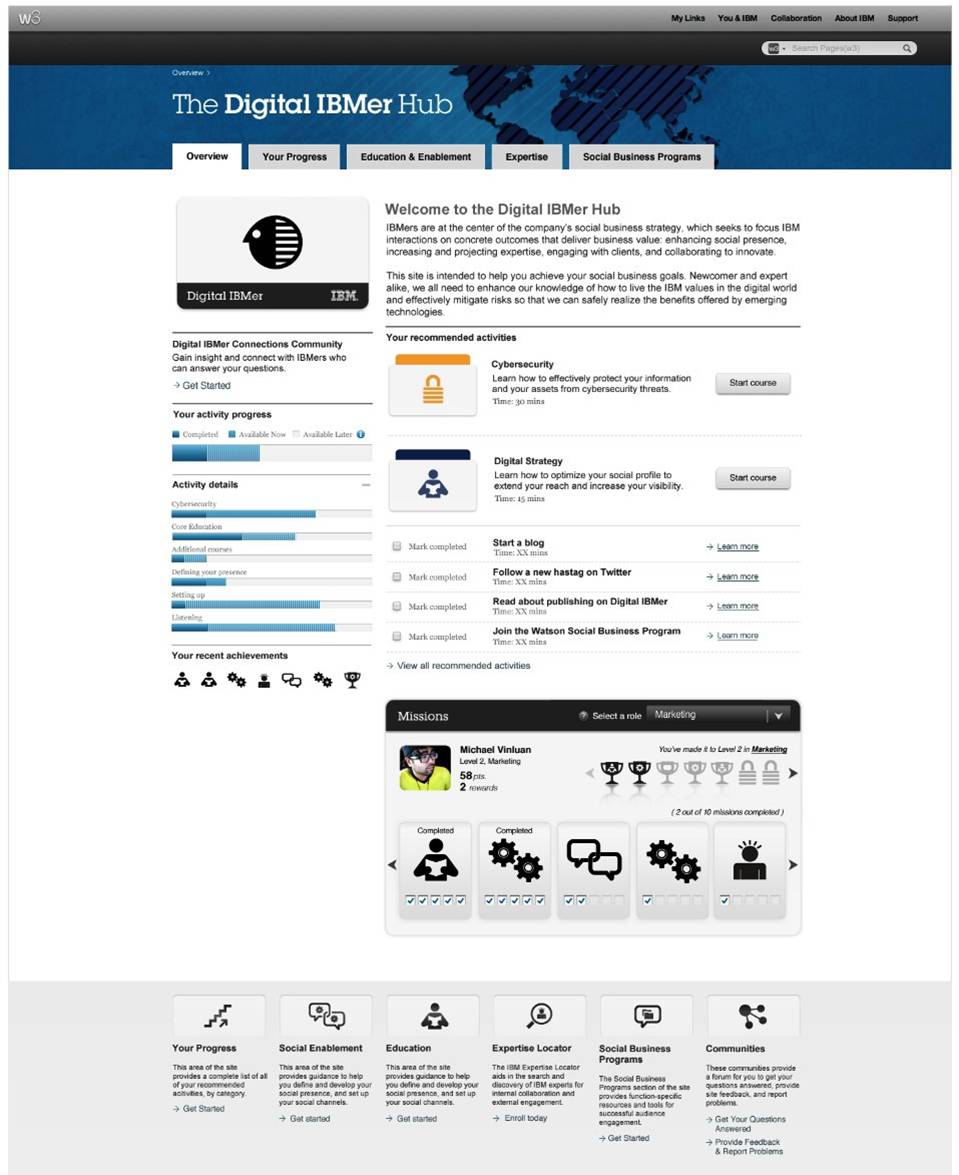
We’ve created over 60 courses available on the Digital IBMer Hub, IBM’s employee training portal, to educate our 430,00+ employees on Social Business best practices. Nearly 200,000 courses have been completed.
This is a tremendous opportunity for the employees, but they may not see it right away. If they don’t see the value for them personally and what they’ll get out of it any amount of time is a waste.
This post was inspired when I served on a panel today at the Social Media Today “Social Shake Up” event with Richard Margetic, Director, Global Social Media, Dell and Sandy Gibson, CEO, Elevate, our panel moderator was, Greg Shove, Founder and CEO SocialChorus. The panel was called “Throwing Open the Floodgates: Empowering Employees” – here’s a brief descriptor: The rise of social media means that employees can become engaged with their customers within their individual capacities. But of course that’s easier said than done. Well ask four important questions: What are the floodgates, what does through them open mean, what are the risks and rewards of dong so and finally, how do you best throw them open?
Our panel moderator, Greg Shove, asked us an interesting question …
“How many hours of social media training are enough for your employees before your brand considers ready to participate in social media?”
Richard, responded explaining the Dell Social Media and Communities University (SMaC U) program requires 8 hours of training before any employee can receive their certification and use the @Dell identifier an officially represent the brand.
The Social Enterprise: Lessons on Content, Internal Advocacy and the Human Element
Today I chatted with BlogTalkRadio’s Kathy Klotz-Guest @kathyklotzguest about the employee advocacy strategy my team has been leading at IBM. We discuss how to contend with the need for content, how it’s not just about technology, and how to balance marketing as both art and science.
With many years of careful strategic planning and implementation, IBM now has more internal employee bloggers/champions than any company around. If you’re interesting in how IBM has been able to scale relationships by being open, decentralizing content creation and trusting (and empowering) passionate employees to carry the torch, you’ll want to take a listen: The Social Enterprise: Lessons on Content, Internal Advocacy and the Human Element
Social Workforce Enablement System Components
What support do your employees and partners need to effectively engage in social to represent your brand?
I’m a passionate believer that sharing knowledge & expertise is a key driver of effective social engagement and it is imperative when establishing personal & brand reputation. Our CEO Ginni Rometty, recently said it like this: “In a social enterprise, your value is established not by how much knowledge you amass, but by how much knowledge you impart on others.”
Over the past few months, I’ve been exploring how IBM’s Expertise Enablement System compares to other leading brands that are vested in supporting a social workforce. This exploration led me to define a set of common components any company will require to drive successful engagement through social. I thought I would share these components here to inspire others who are working on developing such a system for their workforce. If you have additional ideas please share them with me!
Must have common componentry of an effective social business employee enablement program, include:
- Organizational Alignment and Cultural Support from Senior Leadership: Executive commitment and open leadership is key to employee adoption. It is the leadership that sets the cultural tone for the organization. If the leaders embrace social and demonstrate that they practice it, not just talk about it, employees will adopt the company’s social business agenda and follow it’s organizing principles.

- Training: Publicly-facing employees require training to ensure a consistent level of interaction quality.
- Listening & Analytics: Social listening can enable activation, allowing employees to be responsive and even predictive with their actions. Deeper analytics provides employees and the company with an understanding of social engagement as compared to competitors and brand goals.
- Content: Employees who create quality user-generated content stimulate interaction and discussion within their networks. Those who maintain a sustained commitment to such engagements are more likely to be recognized as an authority & become influential around their area of expertise.
- Measurement & Reporting: Employee enablement KPI’s must be tied to business goals. Provided on regular basis, these analytics help employees understand their network engagement effectiveness and allow them to make informed decisions that improve future performance.
- Platform: Curation and selection of appropriate social networks & venues ensures employees are engaged where their constituencies are likely to be participating & seeking expertise.
- Governance: Ensures that each component of the Enablement system is on-point and in compliance with company standards & security requirements
What are the common components of social empowerment systems at your company? Please share them with me, so I can learn from you!
Show me. Guide me. Let me.
An approach to building a training curriculum to improve employee engagement through social media.
Over the course of the last year, I’ve worked with our internal communications & training specialists to lead the develop of an education curriculum to advance employee skills in the area of external social media engagement to benefit our customers and our brand. In this post and several to follow, I’ll share our approach in hopes of helping other brand marketers contemplating building such an education curriculum.
Getting Started
Before you begin creating any materials, it’s important to conduct listening research to understand which venues your customers are most engaged on. Knowing this will help you prioritize the training modules that need to be developed. For example, since IBM’s a large B2B in the tech space, we have specific focus on professional social networks, User Groups, Tech Forums & Communities and Tech related blogs so we’ve prioritized training on these venues. You’ll want to support your employees to advance skills on appropriate venues where your customers & prospects are more likely to connect & develop relationships. Stay away from developing training about the latest tools, there will be several hundred new ones introduced in the next few months and you won’t be able to keep up with them or the enhancements made post release.
Outline clear learning objectives
Once you’ve prioritized the venues important for employees to engage in, you’ll want to map out a curriculum that can accommodate various skill levels from beginner to advanced and begin segmenting the skills each module will deliver. For example:
Blogging 101: The Basics
Learning objectives:
- Identify the basic features of Blogging and its terminology
- Select a hosting platform for your blog
- List techniques to create compelling blog content
- Describe the guidelines and policies for Blogging specific to your brand
Blogging 201: Intermediate – How to Plan, Maintain and Optimize your blog
Learning objectives:
- Identify the need to schedule blogging on your calendar
- Demonstrate how to create compelling content
- List techniques to optimize your blog for search engines to grow your audience
Blogging 301: Advanced – Differentiating and Promoting your Blog
Learning objectives:
- Identify how to differentiate your blog and promote your expertise
- Grow your blog followers and connections
- List tools to help you measure your influence
Training Approach: Show me. Guide me. Let me.
We use a progression of simulations under the framework of Show me. Guide me. Let me. This approach gradually helps learners develop the skills they need to engage in social media on behalf of IBM. More specifically:
1. Show Me (Demonstration): Video simulations demonstrate the steps of procedures to learners, while also showing text that describes the process. Audio is often also provided to explain the steps to learners.
2. Guide Me (Guided Practice): Learners participate in the simulation by clicking the tools they would use in real life, but the tools are simulated. Throughout the simulation, text or audio guides learners through the process within a safe environment where learners can make mistakes without interfering with actual customer information in a live system.
3. Let Me (Assessment): Learners click through a series of steps within lab exercise to achieve desired results, but no guidance is provided during the exercise. Learners rely on their knowledge attained in steps 1 and 2 to complete the simulation. This is the most effective way to know whether learners understand the process.
Training delivery methods
It’s not always feasible to host on-site training. This was the case for us because we’re a global brand, so we use web based collaboration tools like IBM Connections and Smart Cloud to deliver the training. Hosting a series of community based lunch & learns in which the presentation was shared by the trainer during the first 30 minutes and then was opened up for questions and discussion the last 30 minutes. Throughout, participants and moderators are actively using text chat to provide input and ask questions or provide answers. We also recorded each session and made the modules available on our internal intranet portal called the Digital IBMer Hub. Employees to access the modules on demand at a time that is convenient and replay as many times as they like.
Given the quickly evolving nature of social and digital media, you will need the ability to quickly create and distribute training or education to your people—especially as new channels, best practices, or policies emerge or fade. This approach could easily be used to train employees who are active in social media and also to keep them continually equipped with the latest information about your brand.
Trusted Experts engaged in social media are 135% more effective at generating leads
The Practice of Effective Social Business Program Management
Social gives you the ability to connect human beings with one another and ignite conversations around shared topics of interest relevant to your brands priorities. So if you’re thinking about social as just another channel to push content through, think again.
As you build your social program, identify insights and key learning’s from your listening research. Evaluate the ecosystem of people and connections. Think through how you can create a presence that will appeal to those you want to build relationships with and who would be best suited to be the focal point. Most likely, it’s not a marketer. Rather, focus on encouraging dialogue with your employees who have expertise to share. These leaders will not only have valuable knowledge, they also hold the promise to become the most trusted and credible within a relationship.
Like any other tactic or channel, social should not be approached independently but with an eye towards fulfilling your larger objectives. As you begin to think about your social plan ask yourself what role it will play in achieving your overall goals? Defining and identifying realistic ways to measure success are critical steps in creating the framework for a successful program.

Another crucial element in the early stages of developing a social program is performing listening research – this is how you get to know your audience and come to understand where they like to spend their time online and what kinds of content and tactical approaches they are most likely to respond to.
A change Agent – The emerging role of the Social Business Manager
Social business management is undertaken by people who create and engage in social digital experiences on behalf of your brand. At IBM, there’s a new role emerging, the Social Business Manager. This individual not only collaborates closely with the extended marketing management team to provide oversight for all aspects of a social business program including social listening research, planning, engagement and measurement. They also act as a change agent. 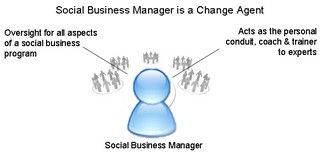
They’re driving cultural change and adoption of social through their commitment to:
- Work with employees as a relationship manager and coach
- Provide direction to employees on relevant influencers, external brand champions, partners and competitors within specific topic area. Help employees establish priorities which relationships to focus on.
- Provide supporting assets, program guidance, training and critical feedback to those employees engaged in social outreach
Through some early pilot work I’ve been leading, we’re able to quantify that engagement with influential experts in social media is 135%* more effective at generating sales leads than traditional digital marketing tactics. Another way of saying this is, trusted SMEs who share their expertise online are 7x more likely to drive initiations with a call to action (offer) when compared to other digital marketing tactics in the same period.
This is a win-win for the brand and employees. The employees benefit from building their professional reputation and increasing their visibility in their field, while they drive the brand’s influence and support lead development in the market.
If you’re approach social as just another channel for marketers to manage and push content through, think again.
*IBM Select Social Eminence pilot 3Q2012