The Smart Sceptic’s Guide to Social Media in Organisations

Colleagues, family and friends know I love to mentor, teach and guide, especially aspiring women leaders. Said another way, I love to encourage others to find and spark their “inner expert”. Helping them share their knowledge and thought leadership. I did this professionally for so many at IBM through the employee advocacy program I created called the IBM Select Social Eminence program, affording me the amazing opportunity to work with social business leaders across the globe. Also, I was lucky enough to have been inspired by Gini Rometty, CEO IBM. An amazing leader and the very first female CEO of the 100+ year old company, where I spent 18 of years of my career. Ginni taught me that ….

“In a social enterprise, your value is established not by how much knowledge you amass, but by how much knowledge you impart on others” ~ Ginni Rometty, CEO IBM 

You can read more about this in this post about the 10 Benefits of Social Business Collaboration

Meet Yekemi Otaru  

Yekemi Otaru, Author of The Smart Sceptic's Guide to Social Media in Organisations
Yekemi Otaru, Author of The Smart Sceptic’s Guide to Social Media in Organisations

I was fortunate to have the opportunity to become a protege to Yekemi Otaru several years back when she graciously reached out to me while researching and writing her masters thesis. Interested in tapping my expertise leading social business initiatives for IBM, a global enterprise with over 430,000 employees. The title of her thesis: Employee participation – the influence of enterprise learning during evolutionary change: a mixed method study into social media implementation (Distinction, 80%).

Right in my wheel house!

I’m proud to say that Yekemi has completed her Master of Business Administration (MBA, Distinction) Henley Business School and earned a distinction in Change management, Marketing in high tech industry.

Well it doesn’t stop there! Yekemi, like me is always reaching higher. This month she did just that by becoming a published Author! The title of her first book is: The Smart Sceptic’s Guide to Social Media in Organisations 
Screen Shot 2016-01-31 at 2.13.42 PM

If you are considering employee advocacy for your organisation but you are not sure how to sustain the participation of your employees on social media, Yekemi’s book offers a three-step framework developed through research and real life examples.

Yekemi’s book is an interesting compliment to my book called The Most Powerful Brand on Earth. Both works help business leaders navigate with proven methods how to equip a social workforce. Further, customers trust expert social employees more than any other source.

While, Yekemi and I have never met in person (that would be a luxury I hope will happen some day!), we’ve collaborated by phone and across various social networks (LinkedIn, Twitter mainly) and across the Atlantic Ocean. Yes, This is the future of work!

Like me, Yekemi is a working Mother and business leader. She lives in Aberdeenshire, Scotland where she and her husband are raising their two beautiful children and striving for balance daily to make it all work in pursuit of her passions. She has worked in engineering and marketing roles at multinational companies such as Schlumberger and General Electric. Now an experienced strategy and marketing professional, Yekemi brings her unique reasoning and writing to tackle the challenge of social media, branding and the digital space in more conservative sectors such as oil and gas, medical, pharmaceuticals and manufacturing.

Connect with Yekemi – she blogs at thetaskmistress.me  follow her on Twitter @Mrstaskmistress  and buy a copy of her book on Amazon UK

Employee Advocacy: Program engagement doesn’t imply program success – part 2

As a follow up installment to my last post titled: Employee Advocacy: Program engagement doesn’t imply program success, I hope this follow up installment provides you considerations that will help you better understand why starting from the frame of reference of employees is critical.

Considering the vantage point of the employee, why is this so important?

  1. In order to truly encourage employees to engage in an employee advocacy program, you must start with defining and demonstrating how actively engaging in the program will help them increase their visibility amongst customers, influential decision makers, colleagues and industry influencers. Yes, that’s right, I also said demonstrate. That means you’ll need to develop case studies / real examples for employees to reference to help them get the picture.
  2. Start by designing education and support materials around common questions and objections employees have. If not answered from a benefit or position of value, employees will not adopt.
  3. When you design the program with these objections/questions in mind you’ll learn more about what employees are experiencing and you’ll be able to so when they’re raised we have a module/guide to address them in a playbook. This playbook becomes a helpful reference as you extend the number of program managers and participants. You can evolve it over time. Consider deploying a learning hub with a forum component that allows you to gather feedback and field questions. If employees are heard and secure support when they ask for help, they’ll increase their engagement.
  4. Be sure to educate them so they understand how engagement will help them work more effectively, efficiently and last but not least – – how they’ll get recognized for their efforts. It truly is a critical foundation that many brands miss when designing employee advocacy or social selling programs, often thinking that gamification or leader boards are all it takes to drive engagement. While these may help, I’ve learned that the most important and highly regarded form of recognition employees seek is visibility, you can read more about that in this post: What’s the #1 incentive employees seek from an Employee Advocacy program?

Screen Shot 2015-10-31 at 1.53.34 PMSo what are the most common questions employees may have? Here’s a few examples, that’ll help you get started:

  1. Why is engagement on social (for business/professional) something worth my time?
  2. Why me? Isn’t this kind of engagement for an intern who knows how to engage on social?
  3. Why should I focus my time on this when I have all these other pressing demands in my job role?

Which then leads into several other questions such as:

  1. How do you define “engagement”?
  2. What is expected of me?
  3. How will I be measured? Compensated?
  4. What are the guidelines?
  5. What training is provided?
  6. Will I be assessed for this?
  7. Is this mandatory?

The key here is to define the value proposition from the vantage point of the employee who will in the end be the lynchpin of the programs adoption and engagement success. The answers must be defined as benefit statements for the adoption and engagement … such as the benefits of:

        • How sharing and receiving knowledge helps them access to new ways of thinking, access to answers for challenges they’re grappling with and learning from someone who’s already figured it out
        • The benefits of being positioned as a thought leader, networking and relationship development, and how they’ll tap into the intellect of influential prominent thought leaders that are paving the way

The program foundation must include guidance for employees, a playbook that anyone in your company can tap for engagement guidance, it includes such topics as:

  • Policies
  • Procedures
  • Access to FAQs and directions for access to “go to contacts” for further help
  • Brand engagement guidelines
  • Safety and Security
  • Disclosure
  • Basic training portfolio

Consider tying adoption and engagement to the basic competencies for staff development and assessment. For example:

  1. Certification of completion is tied to learning/training objectives for all employees and is tied to skills development requirements, qualifications and assessment criteria used by HR and Management in the review, talent advancement and acquisition system.
  2. Focus on adoption and engagement for key segments of your employee population that will help achieve the highest priority business goals first, then expand from there.

sun-burstIt’s essential to have a core team that will actively manage the program and provide support to employees as they advance along the journey. If you need further guidance, reference the second chapter of my book: The Most Powerful Brand on Earth“Help you people do well” which explains how to establish a program framework which provides the foundation for your people to create and nurture relationships that drive engagement and create business value. Specifically, you’ll better understand how to plan the roles and skills needed, then attract, onboard, support, and measure the people whom you empower in social media.


Employee Advocacy: Program engagement doesn’t imply program success – part 1

I’m asked repeatedly, “What’s the secret to driving employee engagement for employee advocacy programs?”

The reality is, there is no secret recipe. In this post I’ll share a few thoughts which I hope aide you in evaluating the design of your Employee Advocacy program and help you make the necessary adjustments to drive more employee engagement.

To be sure we’re on the same page, let’s start with what I mean by “Engagement”. My starting premise is that the employee has already agreed to:

  1. Participate in the employee advocacy program
  2. Has been through the pre-requisite on-boarding, training and certification steps required to be officially granted program participant status. This means, they’ve been fully trained and equipped to engage across the social web, they understand the companies guidelines, policies, governance model.
  3. They know their role and how their engagement aligns to helping the company achieve specific goals.

If you need further guidance, reference the second chapter of my book: The Most Powerful Brand on Earth“Help you people do well” sun-burstwhich explains how to establish a program framework which provides the foundation for your people to create and nurture relationships that drive engagement and create business value. Specifically, you’ll better understand how to plan the roles and skills needed, then attract, onboard, support, and measure the people whom you empower in social media.


Program engagement doesn’t imply program success.

Employee engagement in the program is a means to an end. Constant, high engagement is a condition for a successful Employee Advocacy program, but it’s not enough.

Unfortunately, program engagement rates are sometimes considered as the most important key performance indicators (KPIs) for the program’s success. As a result, program managers are tempted to adopt tactics that will artificially boost engagement in the program. Stop right there! Increasing the amount of activity will not impact achievement of program’s goals such as driving an increase in lead generation or increased prominence and ability to influence to drive consideration, preference and choice of your brand’s offering.

To address this, make sure that you are clear on how your program defines program “success” standards:

    • Align the Employee Advocacy program’s goals with business objectives
    • Define the Employee Advocacy program’s success in terms of business impact (sales, conversion rates, cost savings)
    • Establish meaningful business KPIs for program’s success, which are trackable and quantifiable
    • Link performance assessment of Employee Advocacy program managers to achievement of program’s goals (aligned with business objectives), not to program engagement KPIs

The basis of the word “engagement” means commitment.  Approach engagement and adoption from the value to the employee in service of customers and your business will benefit. 

How to choose a Employee Advocacy software technology partner

Employee advocacy is becoming a mega trend. So much so, there are now over 30+ technology platform providers in the space within the last 2 years alone. If you’re considering evaluating employee advocacy software technology to support your employee advocacy program, this post is for you!

The most important first step has nothing to do with technology. 

Yes, really! First a foremost, you must establish clear business goals that your employee advocacy program is designed to support. If you don’t establish these and reach a unified agreement amongst company stakeholders on them, no technology platform can help you. Establishing clear and attainable goals is step #1. These goals must not only be clear and agreed upon, they must also be measurable! Otherwise you run the risk of not being able to evaluate program success by measuring performance and tracking progress over time. If you don’t sort this out first, your employee advocacy program will likely be short lived because you won’t be able to secure the needed investment and resources needed.

Once you’ve got your foundation of goals and how you will measure success in place, the 5 steps below provide you a proven roadmap. This isn’t simply my opinion. These are tested and proven. I followed these 5 steps with my team at IBM when we were evaluating and determining the optimal fit Employee Advocacy software platform for the global tech giant. I hope that they’re helpful to you:

  • Determine your business requirements for the technology before you begin evaluating any product, or requesting vendors bid on a Request for Proposal (RFP).  This sounds obvious, but I’ve learned from clients and colleagues who’re leading Employee Advocacy programs for their brands, this is often a step they missed. Work with your team and stakeholders to gather, catalog and prioritize business requirements that are “must haves” for a successful implementation of your Employee Advocacy program. Starting with business requirement will help you review platform options with the same criteria. Once you have this inventory, you can begin to prioritize the “must haves” against other functional features and sort through features that are “nice to have” but not critical your program.
  • Demo as many Employee Advocacy platforms as feasibly possible, a great way to do this is by attending conferences.  Be sure to take your “must have” criteria list and evaluate them first hand through demos and trials. In addition to evaluating the multitude of Employee Advocacy software platforms first hand, you’ll benefit from talking directly to the development and/or sales team.  This also allows you the opportunity to get to know the staff that you’ll likely be interacting with. You want to be respectful of their time. Remember that they’ll most likely need to help others who are at their booth wanting to see a demo. So if you think their offering may be on your short list, ask them if they would be willing to schedule a private demo while you’re at the event. This way you can run through your list of must have’s with their help and you won’t be feeling pressured by the line of others who are interested in accessing the demo and are vying for attention along with so many others waiting in line behind you.
  • Beware of the “Shiny object” syndrome. While you might see and learn about exciting new capabilities you never knew about during the demo phase, it’s critical not to forget that you and your team spent a great deal of time pulling together your requirements list, establishing the “must have” features for your employee advocacy program. Be sure you’re evaluating your options based on your program priority “must haves” and avoid running the risk of getting enamored with a bunch of shiny new technology functionality that looks cool but you may not ever use.
  • Be realistic about what you can afford! A saying my Dad used often was … “you have Champagne taste on a Beer budget” … Don’t let this happen to you while you’re evaluating employee advocacy platform options. You’ll need to secure financial support not only from your stakeholders, but also your procurement team. So be cautious of your limitations and evaluate options with the financial reality and any procurement limitations (i.e. the specifications for providers you can transact business with) in mind.
  • Form follows function This well-known architecture principal, originally defined by the great designer Louis H. Sullivan should be applied to the evaluation of Employee Advocacy software. Remember that the technology platform you select must be implemented within the business infrastructure your company has in place. Where “function” is the enterprise technology infrastructure, architecture, and business processes that any choice must integrate with, “form” is the Employee Advocacy software that will need to work within it. It is critical to follow the form follows function principal. Consider how your program operates within your business model and evaluate how the software will need to be integrated:
    • Will you require it to connect to your lead generation process?
    • Your Sales and/or the Customer Care operation at your company?
    • Your analytics, social/market intelligence and/or reporting functions?
    • Your CRM system?

Consider these system integration requirements up front. If you don’t, the business is likely to suffer from your choice down the road and be fraught with challenges to integrate with existing processes and systems costing you more even more money in the long run.

Do you have other steps you’ve found to be critical? If you have, I’d love to know what they were, please post a comment with your feedback.

Employee Advocacy Lead Generation: An “always on” marketing channel

Nearly all brands struggle to remain competitive and are seeking ways to do more with lower budgets.

Lower budgets along with the growing trend that people are more skeptical about messages and content that comes from official brand channels. So, what’s a marketer to do?

Sound familiar?

Enter your Employee Advocacy program


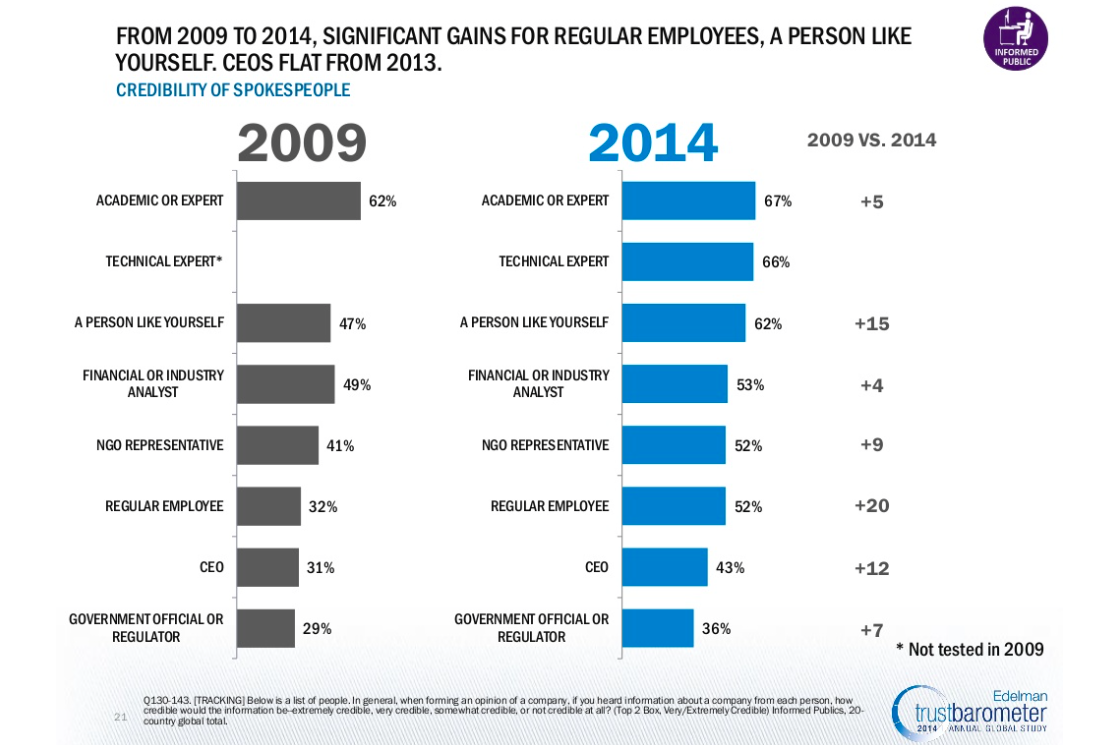
The good news is, people are more receptive to content that comes from a network connection. In fact, people trust regular employees as credible spokespeople more than official brand sources like the CEO, as shown by the 20 point gain since 2009, in 
Edleman’s 2014 Trust Barometer study. In addition, the study reveals that employees rank highest overall 36%, as the most trusted influencer to communicate across 4 out of 5 topic categories including: Engagement, Integrity, Products & Services and Operations.


Screen Shot 2014-07-29 at 12.00.23 PM


Because content from a connection is inherently more trustworthy or “valid”, it’s more likely to be opened, clicked, shared, and ultimately converted into a lead or sale. And since employees use social media around the clock, your Employee Advocacy program becomes an always-on lead generation channel.

Screen Shot 2015-04-25 at 7.14.06 PMLeading brands are increasing investment in digital marketing and Employee Advocacy programs that create business value through equipping and empowering employees.


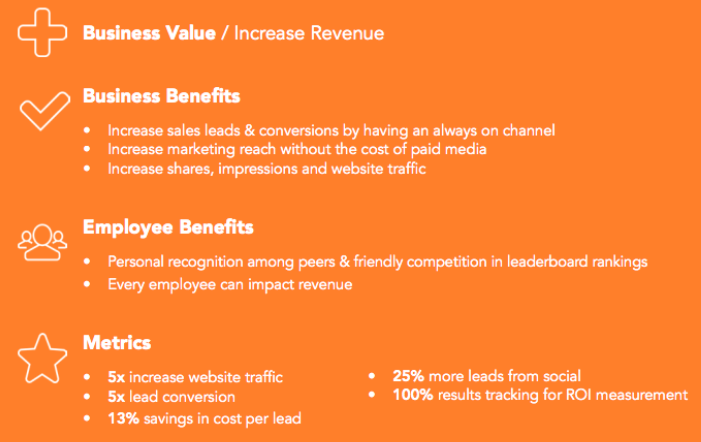
The most common sources of value from such programs usually include increased revenues from employees who generate more leads and conversions to a call to action as compared to paid media.

Screen Shot 2015-04-25 at 5.10.14 PM

For more on this and other ways to drive business value from employee advocacy, download the eBook: Making the case for Employee Advocacy, 5 winning use cases that enable consensus and collaboration


How IBM Drives ROI Through Employee Advocacy

Today, I had the good fortune of hosting and moderating a webinar How IBM Drives ROI Through Employee Advocacy, featuring my long time IBM colleagues Colleen Burns and Amber Armstrong, who shared several case studies about how the global tech giant is successfully proving ROI through employee advocacy.


Screen Shot 2014-11-20 at 10.36.25 PM

For those of you who’ve followed me on twitter @sfemerick or read my blog or book, The Most Powerful Brand on Earth, you know I believe the most successful brand advocates are those who gain visibility and trust by sharing their expertise, and the most successful brands are those who build systems around these experts to align and scale impact for the brand. IBM has done just that. 

Kicking off our discussion by establishing a common understanding of how we define Employee Advocacy – meaning: brands empowering employees to support the goals of the brand, using content and employee-owned social — As explained in the book, this could also be extended to business partners or even customers. (The full webinar on demand is available towards the end of this post.)

But why should brands care?

Well, for starters Employee Advocacy is the fastest growing and most effective means of driving brand engagement and advocacy at scale. Secondly, customers trust your experts and regular employees more than anyone else in your company.

In fact, people trust regular employees as credible spokespeople more than official brand sources like the CEO, as shown by the 20 point gain since 2009, in Edleman’s 2014 Trust Barometer study. In addition, the study reveals that employees rank highest overall 36%, as the most trusted influencer to communicate across 4 out of 5 topic categories including: Engagement, Integrity, Products & Services and Operations.

Slide05-editProve value to your stakeholders, or your program will be short lived

If you’re contemplating an employee advocacy program, you’ll need to consider how you’re going to measure, demonstrate value and deliver results. If you miss this critical step, the likelihood of your program being short lived is pretty high because you won’t be able to secure the resources or investment you’ll need.

While ROI targets are typically financial, such as Increasing revenue or decreasing costs, they may also be non-financial such as increasing productivity, improving operational efficiency or reducing time to market which have financial implications. No matter which is right for your program, you need begin with establishing measurable ROI targets for the program up front. It’s not enough to set targets, you also have to determine how you’ll measure and report progress against them.

Another critical step is to consider what motivates stakeholders – depending which part of your company is sponsoring your program they will likely have different motivations and attainment measures, the details on addressing stakeholder motivations is explained in Chapter 7 of The Most Powerful Brand on Earth. We also dedicate a whole chapter to measurement, where you can find a roadmap of how build a measurement framework.

IBM’s a leader in social business, committed to driving transformation, paving the way for open collaboration and employee engagement

Colleen Burns, Manager of IBM’s Influencer Engagement Team, shared IBM’s belief that employees are one of the greatest sources of influence. Not just in IBM products, but in the entirety of the company. IBMers (as employees call themselves), play a critical role helping to set the agenda, as well as build and cultivate relationships.

The IBM Redbooks Thought Leaders Social Media Residency is a great example. The program was designed to create a pipeline of thought leadership blogs and help motivate technical employees to establish their personal social eminence while sharing their technical knowledge and expertise while building engagement opportunities. Since it’s inception in 2011, program participants have authored nearly 2,000 blogs across 11 business topics. In fact 800 posts published on IBM’s Thoughts On Cloud blog have accrued 1.1 Million visits and counting!

IBM’s Select program, designed to identify high-value experts to support social strategies aligned to go-to-market priorities, enabled SMEs to tag links and track inbound referrals from their personal blogs. This program has quantifiably outperformed traditional marketing and paid media tactics, proving digitally engaged experts could achieve a 33% conversion rate to a call to action.

IBM is also helping customers like Performance Bicycle achieve results by creating a community based learning center, which has become the Go-to destination for cycling enthusiasts. Moderated by employees that are cycling experts, they’ve achieved a 300% increase in traffic within first four months while proving a 20% higher conversion from the Learning Center compared to other referral sources.

IBM’s work with Illy, an Italian coffee and accessories retailer, resulted in a 40% increase in traffic to the retailer’s online shopping catalogue.

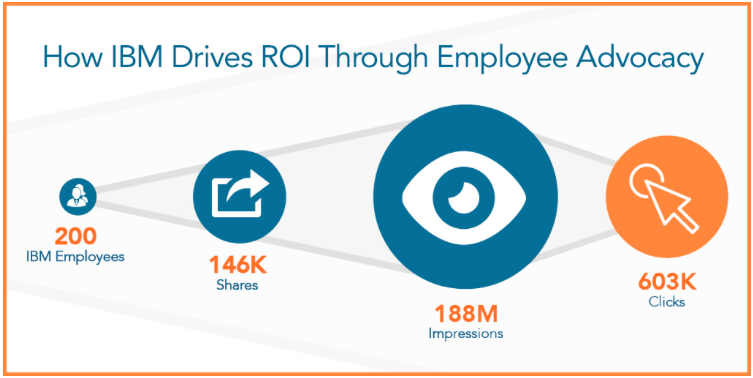
Slide20-smallAmber Armstrong, Program Director of IBM’s Social Business team, launched a unique employee advocacy program powered by Dynamic Signal with 200 initial subject matter experts (SMEs). This elite group drove 146K shares to date, resulting in 188M impressions and 603K clicks through to the call to action. An estimated cost savings on media spend between $300K – $1.2M.

Slide21-editWow! What an incredible demonstration of ROI
If you’re striving to build a successful employee advocacy program and missed today’s webinar, you can access the replay below, and can also follow and contribute to the dialogue on Twitter using the event’s hashtag #AdvocateArmy

A special thanks to our webinar sponsors BrightTalk and Dynamic Signal


What’s the #1 incentive employees seek from an Employee Advocacy program?

Nearly every event I speak at on Employee Advocacy, I’m asked by business leaders, “What incentives do you find work the best to motivate employees to engage?”

This question was raised when I was honored to speak at the Social Media.Org Brands Only Summit, where there over 300 brands were Screen Shot 2014-10-26 at 8.50.36 PMpresent.

So,“What incentives do you find work the best to motivate employees to engage in an employee advocacy program?”

Do you suggest paying them?

Do you provide prizes?

Do you use leaderboards?

What about gamification techniques?

While these may provide a limited lift in engagement for some brands, I would say none of these are what employees are truly seeking. So what is it that motivates employees to engage in a committed way to share their expertise and great news about their companies? Two words:

Visibility and recognition

Top most is visibility amongst coworkers, managers, but most importantly Senior Leadership. Followed by recognition for their commitment and dedication. It’s truly that simple!

So what are you doing to integrate visibility and recognition types of rewards into your Employee Advocacy program?

Here’s a few ideas you may want to consider:

  • Start a column to recognize the most dedicated employees that are the most committed to regularly engaging to drive the program and company goals forward. Run this column in your company newsletter and create a feature story series on your intranet or company blog.
  • Create a monthly opportunity for Senior Leaders to recognize employees verbally on a management call. A simple mention of the employee with examples of how their efforts are driving results is a fabulous way to motive employees and spread the good word to management and the C-Suite as well as inspire others to engage.
  • Take advantage of company events where leaders can recognize the efforts of the top most engaged employees publicly amongst their coworkers. There is nothing more gratifying that public recognition.

IMG_3700You will find more on this topic during the Q&A of this video where I’m asked this question and more. Also, there is a whole section about rewards and recognition in my book, The Most Powerful Brand on Earth see Chapter 2: Help your people do well

Best selling author and founder of Social Media.Org the one and only Andy Sernovitz pictured with me. What a great event!

“The Most Powerful Brand on Earth,” presented by Susan Emerick from SocialMedia.org on Vimeo.

Sprinklr aquires BRANDERATI adding Employee Advocacy at scale to its portfolio


Sprinklr, the leading independent end-to-end social relationship infrastructure, announces the acquisition of BRANDERATI, the industry’s foremost platform for employee advocacy and influencer marketing.Screen Shot 2014-09-03 at 8.55.22 AM

I had the opportunity to discuss the details of the acquisition with my long time friend and colleague Ekaterina Walter @Ekaterina, who’s been a pioneer of influencer engagement and advocacy for many years, most recently as CMO of Branderati. She is now joining Sprinklr as Global Evangelism Lead. Below is a synopsis of our discussion covering how the partnership formed, the robust capabilities it brings to brands, what it means for the industry and more …


Susan Emerick: You’re an inspiration to me personally and professionally. It comes as no surprise that you’ve been a part of spearheading this partnership, which provides brands such a powerful suite of capabilities. What would you describe sets it apart from the growing number of software providers in the growing advocacy space?

EKaterina Walter: Sprinklr bought us because Ragy (Thomas) @ragythomas understood that advocacy has moved from hype to real business driver. Sprinklr’s charter is to provide end-to-end social media infrastructure. To fulfill this mission, the company needed to add advocacy marketing as a core, integrated module that acts as a seamless extension of the social stack. 

Branderati technology and expertise brings several things to the equation. 

First, our screening technology captures API and self-reported data to align potential advocates with predefined profiles of ideal ambassadors. This technology is critical for any brand looking to create highly vetted advocacy networks at scale. By combining this screening process with the ability to identify candidates across moderation, social listening and CRM, we will deliver the most complete advocacy recruitment solution in the marketplace. 

Second, from an engagement standpoint we bring the ability to create entire members-only programs that are highly targeted and personalized to each ambassador. By combing this engagement platform with the larger campaign management and scheduling functions in Sprinklr, the platform becomes a unified command center for activation of both advocates and the broader community. 

Third, from a measurement standpoint there are very specific types of tracking data we provide in order to track ambassadors’ true impact. By bringing deep views of this insight into the main reporting suite of Sprinklr we provide a single source for nearly your entire paid owned and earned social impact. 

Lastly, Sprinklr acquired focused expertise. We have been managing sustained advocacy programs since 2010. The experience and best practices will be a huge benefit to future Sprinklr product development and to their clients. 

Susan Emerick: As you know, I’m passionate about employee advocacy, not just equipping employees with training and content but also helping them engage more effectively with customers and influencers based on social intelligence. What does this acquisition bring to brands that are serious about investing in Employee Advocacy?

EKaterina Walter: It gives brands an integrated approach to activating their internal advocates and offers end-to-end social business solution. Every day, Sprinklr clients are identifying active and potential advocates (both internal and external) through community moderation, social listening and the platform’s powerful audience CRM tools. Their biggest challenge is: how do I activate the right advocates at the right time to align with the Brand’s promotional priorities. Branderati delivers the answer.

Furthermore, the integration of the reporting framework between Branderati and Sprinklr will end “apples & oranges” KPI’s between social campaigns and advocacy programs and provide the full picture of social impact, all in one elegant place.

Susan Emerick: Influencer engagement is complicated. How does this acquisition help brand leaders focus on the most relevant influencers to their business?

EKaterina Walter: The key to identification and recruitment of influencers and advocates is to recruit and identify the right ones.

For that you need to first and foremost know your goal. If you are not clear on what you want to achieve with the program, no number of influencers will be able to help you. Then you align your goals with people. Then you need to understand what communities those people belong to, where they are, what conversation they are driving, etc. Context in this case trumps follower numbers. One person who has 500 followers but leads a passionate community in one particular topic can be way more influential than a generic influencer with 500,000 followers. Influence in this case is defined by the ability to drive actions (conversion, purchase intent, purchase), not just generic conversations.

That is what we help brands establish. A combination of factors that helps define that context is critical to the impact of advocacy or influencer program.

Susan Emerick: The proof continues to mount from industry research that shows trusted relationships in social are most often what people base their purchasing decisions on. What do you anticipate this means for the way Brand leaders need to invest differently?

EKaterina Walter: According to your own IBM data CMOs are considering brand advocacy and loyalty their top priority. But unfortunately up to date not a lot of brands truly invested in the advocacy programs, both internal and external. And if they have, they limited themselves with “borrowing” influencers from platforms that “collect” them. This is a one-night-stand approach and it usually doesn’t drive true business results (though it can drive some awareness). Executives need to invest in evergreen and sustainable advocacy programs that not just spark brand love, but allow for that spark to burn bright long-term, thus building relationships with the right people, in the right place, and in the right way. That community of loyal advocates, will not only carry your brand’s torch, but shine it on the rest of the world. You do it right, you will never have to pay for a new customer again.

For more on the acquisition visit www.sprinklr.com


A new beginning: Launching Brands Rising

There has never been a more a more exciting yet terrifying time in my life. As you may know, I recently made a leap into becoming an Entrepreneur after an incredibly fulfilling career with IBM. Yes, on the road to reinvention, a huge step or perhaps a better word is ‘risk’ for sure, but one that after much soul searching and contemplation, I felt I would regret if I didn’t give it a go.

I’ve joined forces with a long time IBM colleague, Jeanne Murray. The new venture is called Brands Rising and we’re open for business!  We are strategic advisors to companies building employee advocacy programs in social media. We specialize in helping companies develop program strategy, training curricula, and business intelligence and measurement frameworks. We’re skilled at working with brand leaders no matter what stage of the maturity curve they’re in to deploy employee advocacy programs that drive business value at scale.

These links on our website have more details about what we do and who we are, but in a nutshell:

We know how to help companies impact the bottom line through social media engagement. We have experience, we’ve learned from success (and mistakes), and we are laser-focused on business results.

But nothing speaks louder than when others speak out on your behalf! Jeanne and I were both humbled by this post from Greg Gerik who shares his views on our new business.

We are excited about the opportunity to work with leaders who have a vision – like we do – of satisfied customers, shared expertise, and a network of people who learn from each other.

Let’s get started!

How to unleash a brand’s most valuable resource, employee advocacy

I had the pleasure of sharing my experience of co-authoring a book about building a successful employee advocacy program, The Most Powerful Brand on Earth, on Bryan Kramer’s popular podcast series ~ “From an Author’s Point of View”.

Screen Shot 2014-09-03 at 3.55.49 PM

In addition to sharing my journey as a first time author, we discussed the book content, which is based on my experience building and implementing a successful employee advocacy program at IBM and that of many others who’ve led brand reputation initiatives and employee advocacy programs at global companies. It provides a full roadmap on how to unleash a brand’s most valuable resource, engaged employees, who build credibility through sharing their knowledge in social media and becoming employee advocates.

I hope these insights will inspire you to invest in building earned relationships that last. [button link=”#http://www.bryankramer.com/the-most-powerful-brand-on-earth-with-susan-emerick/” newwindow=”yes”] Listen[/button]