There has never been a more a more exciting yet terrifying time in my life. As you may know, I recently made a leap into becoming an Entrepreneur after an incredibly fulfilling career with IBM. Yes, on the road to reinvention, a huge step or perhaps a better word is ‘risk’ for sure, but one that after much soul searching and contemplation, I felt I would regret if I didn’t give it a go.
I’ve joined forces with a long time IBM colleague, Jeanne Murray. The new venture is calledBrands Rising and we’re open for business! We are strategic advisors to companies building employee advocacy programs in social media. We specialize in helping companies develop program strategy, training curricula, and business intelligence and measurement frameworks. We’re skilled at working with brand leaders no matter what stage of the maturity curve they’re in to deploy employee advocacy programs that drive business value at scale.
We know how to help companies impact the bottom line through social media engagement. We have experience, we’ve learned from success (and mistakes), and we are laser-focused on business results.
But nothing speaks louder than when others speak out on your behalf! Jeanne and I were both humbled by this post from Greg Gerik who shares his views on our new business.
We are excited about the opportunity to work with leaders who have a vision – like we do – of satisfied customers, shared expertise, and a network of people who learn from each other.
In addition to sharing my journey as a first time author, we discussed the book content, which is based on my experience building and implementing a successful employee advocacy program at IBM and that of many others who’ve led brand reputation initiatives and employee advocacy programs at global companies. It provides a full roadmap on how to unleash a brand’s most valuable resource, engaged employees, who build credibility through sharing their knowledge in social media and becoming employee advocates.
I hope these insights will inspire you to invest in building earned relationships that last. [button link=”#http://www.bryankramer.com/the-most-powerful-brand-on-earth-with-susan-emerick/” newwindow=”yes”] Listen[/button]
Building a solid business case for a large transformation program like Employee Advocacy, is a game changer. You’ll either get support or your execs. will move on to the next request in their long que. Are you prepared to demonstrate the cost to value ratio? Do you know what motivates the key stakeholders you’re going to need to sell your business case to? If you don’t, the likelihood of securing the necessary resource and investment to get your program off the ground is slim to none.
On the webinar, we all spoke to the real and quantifiable value of Employee Advocacy programs, but none of this is possible unless you start by building a solid business case and securing the necessary investment from key stakeholders. Getting to Yes, requires that you understand what motivates these key stakeholders, in order for them to give you what you need to get the program off the ground.
Here’s a brief summary of what I shared on the webinar on the nuts and bolts of building a business case, you’ll need to consider:
Value Realization
Securing investment – Selling to internal stakeholders
Understanding Motivations
Building the Business Case
The business case for a large transformation program will require both costs and value. If you only estimate the expected value, you do not have a business case; you have a value proposition. It may be very helpful to begin by estimating only the value proposition to determine whether you should spend the effort to develop a complete business case. There is nothing wrong with that. Just be sure to develop the full business case, with costs clearly identified, before investing significant resources and energy into the program. The most common sources of value include increased revenues and decreased costs, or efficiency and productivity gains. For example, revenues can increase when employees generate more leads or conversions. Costs can decrease if employees generate conversions at a lower cost per conversions —or— if employees answer customer questions in ways that cost the brand less per customer.
Another example might be, in your marketing campaigns, you may be able to create business value by empowering employees with the skills to condition the market, to persuade potential customers, or to create consideration and preference through their authentic trust and credibility with decision makers and those who influence them.
In such cases, you may find that costs of leads, conversions, recruitment, and sales improve through your program.
In general, the business case should clearly support the current goals of the business. Such business goals typically include goals for the current fiscal year or longer-term strategic goals. While you may be able to secure a small amount of pilot funding without having to show how your program supports the official goals of the organization, programs like this are only truly successful when they scale to touch the majority of the organization. In most organizations, that level of investment will only be granted if you can show how the program contributes to the most important goals of the organization for the upcoming fiscal periods.
Let’s break this down further, considering Value Realization
You should establish a method for proving the program’s value over time. This is necessary for two reasons: First, you need to establish a feedback loop to help you understand whether the program is on track. Second, you should hold yourself and your team accountable for delivering the results you forecast when you requested funding for your program.
As you develop the business case, think about the ways that you will track and prove progress of the program. For all of the ways you plan to impact costs or revenues, determine how you will track that impact over time. For example, if you believe that employees will be able to generate Web traffic that leads to conversions, determine how you will measure the traffic, the conversions, and the costs of the conversions. Also remember to measure the current state of conversions and their costs before starting the program, so you have a baseline metric against which to compare.
Value realization reporting should be a permanent part of your program management activities, so you will need to plan for resources who will gather, analyze, and report the necessary data.
Next, you’ll need to think about Selling to Internal Stakeholders
Getting executive support is as much about educating the executives as it is about building the business case. In this context, selling is more about consulting, educating, and enabling the executives. It’s critical to know what motivates the people who can get you resources and investment required. The motivations of stakeholders may be vastly different, in addition to understanding those motivations you’ll need to be clear on how your program will help them achieve their goals. Build your business case around supporting the business goals as specifically as you can and align your justification for the business case to the motivations of stakeholder across an organization that you’re looking to partner with.
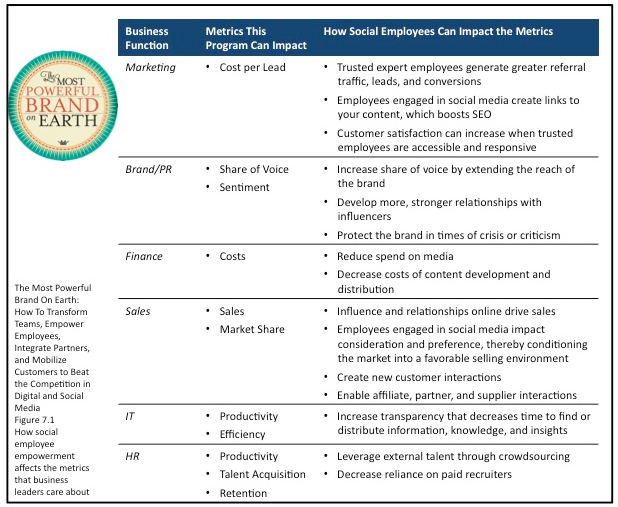
Understanding Motivations – To help you think through what might motivate leaders across different parts of the organization, this illustration from my book The Most Powerful Brand on Earth, describes the motivations and the metrics that stakeholders typically want to see articulated in a business case. You can find more on the nuts and bolts of building a business case for an Employee Advocacy program in Chapter 7: How to Begin.
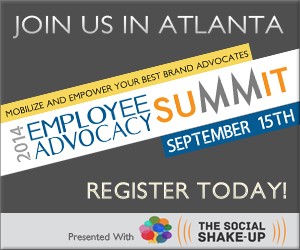
I hope these tips are helpful to you! To learn more, join us in Atlanta for the Employee Advocacy Summit. We have a great line up of speakers representing various industries, ready to show you the ropes based on their first hand experience!
As author Emily Giffin once said, “Everyone wants to belong, or be a part of something bigger than themselves, but it’s important to follow your heart and be true to yourself in the process.” This quote perfectly sums up what employee advocacy is all about: empowering employees to promote their company’s message on social media and, in the process, allowing them to develop their personal brand, and position themselves as trusted advisors and thought leaders in their own networks. I couldn’t agree more! Today, I had the pleasure of sharing my experience leading successful employee advocacy programs and what it takes to empower employees to engage. Getting started may seem daunting. But remember the saying “Rome wasn’t built in a day” … this applies directly to building an employee advocacy program. It takes time, but you have to start somewhere! So here are a few tips I shared on the webinar. I hope they help you to get underway. If you need help, let me know, I’m just a tweet away @sfemerick Tips for getting started: Building the business case: Understand & Articulate Why You are Starting a Program To establish an employee advocacy program, you will probably need to build a business case to explain the value the program will create. Getting executive support is as much about educating the executives as it is about building the business case. They are not necessarily specialists in marketing strategy, or how to pull together a marketing program, or social networking. They will not have the time to stay abreast of the changes and emerging technologies that are occurring and how they’ve impacted the way people communicate. They may not fully appreciate how marketing, sales, and service must adapt to these changes to improve the customer experience. You have to be the expert who helps them understand the way people connect and communicate is changing the landscape of the way decisions are made and who decision makers trust. I shared some important research that can help you educate your executives, including the Edleman Trust Barometer, the Nielson Consumer Trust in Advertising study are good sources that illustrate employees and “people like me” are the most trusted sources of information online. Set Goals and Objectives: Align to business goals and priorities, for example:
New markets
Market growth
Customer Acquisition
Retention and Loyalty
Financial Growth or Cost savings
Make sure program goals and content align with corporate branding initiative Find a Champion. Better yet, be one!Build a pilot with early adopters. Here are some common characteristics of best suited candidates:
Expertise aligned to business priorities, they can be Technical or Business topical experts
Comfortable collaborating, commenting, publishing in social environments
Comfortable with and finds value in creating relationships digitally
Committed to sustaining activity and evolving participation to achieve personal and business objectives
Willing to leverage internal listening capabilities to identify existing social graph and enhance online professional network
I hope these tips are helpful to you! If you can, join us in Atlanta for the Employee Advocacy Summit. We have a great line up of speakers representing various industries, ready to show you the ropes based on their first hand experience! In case you missed the buzz on Twitter today, here’s the full Storify ….
Today is my last day with IBM. It is with deep gratitude that I reflect on my 18 years of service. Over these years, I’ve had the opportunity to work with you! The people across the globe who make IBM a great company. During this time I’ve personally learned, lived by and held dear our IBM values.
I’ve had the amazing opportunity as a “professional hire” to build the capabilities of what was our “Integrated Marketing & Communications (IMC)” organization. Then in 1998, transition into all things digital, affording me the chance to “restlessly reinvent” my skills while successfully propelling IBM into the internet era. What a journey it’s been! From launching IBM.com, multiple global industry sites, advancing the STG Digital & Social Strategy, announcing the historical moment when Watson on Power 7 won Jeopardy, conducting the first Social Listening Study and founding the Social Insights Practice in partnership with MDI, introducing Smarter Planet, celebrating our Centennial, launching IBM Connections while creating some of the first communities which are still thriving, welcoming our first Female CEO, establishing the M&C Labs, leading the advancement of our enterprise digital and social media strategy, governance & policies, scaling innovative programs like Digital IBMer Hub, Forward Thinkers, IBM Select (Social Eminence and Employee Advocacy), IBM.com/voices and last but not least leading the development of our Influencer Engagement Discipline. What an incredible journey, truly I’m proud to be an IBMer!
So … what’s on the other side? you might be wondering. I’m planning to launch a new business venture, providing strategic advisory services. Once my light on Sametime goes out, I’ll be just a click away, so please keep in touch.
Is collaboration critical to your team’s success? Do you work in a globally matrixed environment? How do you foster the kind of open communication on your team that encourages information sharing, learning, partnering on projects, breakthrough thinking?
There are so many benefits to open collaboration in a social business. If your leadership is struggling to understand the benefits, the below short list provides 10 starting thoughts for you to help educate them.
“In a social enterprise, your value is established not by how much knowledge you amass, but by how much knowledge you impart on others” ~ Ginni Rometty, CEO IBM
10 Benefits of Social Business Collaboration
Share your opinion
Seek input from others on their point of view, provide your own point of view by commenting on their posts
Find and share information by tagging content with keywords. This helps you find relevant information by keyword across various content types, such as: Blogs, Communities, Bookmarks, Files, Wikis, Forums. You’ll be able to find information that is posted publicly, or inside a private community that you’re a member of.
Brainstorm with your team
Share an experience or best practice
Share photos or videos
Get project updates in real time
Collaboratively manage a project
Share important and useful links
Share, edit or get feedback on a document with your team
As Employee Advocacy grows into a new mega-trend for brands, business leaders across industries want to know how it will create value and how to best execute within their brand, while ensuring ROI and compliance. To help today’s marketers navigate the complexity of building, scaling and driving performance through Employee Advocacy programs, Chris Boudreaux and Susan Emerick created the 2014 Employee Advocacy Summit, in collaboration with Social Media Today.
Whether you’re just getting started, well on your way, or not sure how to begin, this half-day conference brings you straight talk from practitioners at leading brands, and pioneering industry leaders in the domain of Employee Advocacy.
The 2014 Employee Advocacy Summit on September 15, 2014 in Atlanta will open this year’s Social Shake Up conference, which runs September 16 – 17.
Bring your team and find out what’s really involved in a successful Employee Advocacy program. From strategy and planning, legal and compliance, education and training to contending with the plethora of technologies, performance measurement and how to quantify ROI.
An added plus: the conference will begin with a panel of Employee Advocates who have participated in such programs. They’ll give you the answers to the most commonly asked question: “What’s in it for me?” by sharing their views on the many benefits they’ve reaped by participating in an Employee Advocacy program on behalf of their company.
Regardless of your organization’s size, you will take away proven approaches to mobilize and empower employees to advocate for your brand. Reserve your spot today!
And feel free to contact Susan Emerickor Chris Boudreaux for more information about the event, or Employee Advocacy programs: