
Show me. Guide me. Let me.

An approach to building a training curriculum to improve employee engagement through social media. 

Over the course of the last year, I’ve worked with our internal communications & training specialists to lead the develop of an education curriculum to advance employee skills in the area of external social media engagement to benefit our customers and our brand. In this post and several to follow, I’ll share our approach in hopes of helping other brand marketers contemplating building such an education curriculum.

Getting Started

Before you begin creating any materials, it’s important to conduct listening research to understand which venues your customers are most engaged on. Knowing this will help you prioritize the training modules that need to be developed. For example, since IBM’s a large B2B in the tech space, we have specific focus on professional social networks, User Groups, Tech Forums & Communities and Tech related blogs so we’ve prioritized training on these venues. You’ll want to support your employees to advance skills on appropriate venues where your customers & prospects are more likely to connect & develop relationships. Stay away from developing training about the latest tools, there will be several hundred new ones introduced in the next few months and you won’t be able to keep up with them or the enhancements made post release.

Outline clear learning objectives

Once you’ve prioritized the venues important for employees to engage in, you’ll want to map out a curriculum that can accommodate various skill levels from beginner to advanced and begin segmenting the skills each module will deliver. For example:

Blogging 101: The Basics

Learning objectives:

  •     Identify the basic features of Blogging and its terminology
  •     Select a hosting platform for your blog
  •     List techniques to create compelling blog content
  •     Describe the guidelines and policies for Blogging specific to your brand

Blogging 201: Intermediate – How to Plan, Maintain and Optimize your blog

Learning objectives:

  •     Identify the need to schedule blogging on your calendar
  •     Demonstrate how to create compelling content
  •     List techniques to optimize your blog for search engines to grow your audience

Blogging 301: Advanced – Differentiating and Promoting your Blog

Learning objectives:

  •     Identify how to differentiate your blog and promote your expertise
  •     Grow your blog followers and connections
  •     List tools to help you measure your influence

Training Approach: Show me. Guide me. Let me.

We use a progression of simulations under the framework of Show me. Guide me. Let me. This approach gradually helps learners develop the skills they need to engage in social media on behalf of IBM. More specifically:

1. Show Me (Demonstration): Video simulations demonstrate the steps of procedures to learners, while also showing text that describes the process. Audio is often also provided to explain the steps to learners.

2. Guide Me (Guided Practice): Learners participate in the simulation by clicking the tools they would use in real life, but the tools are simulated. Throughout the simulation, text or audio guides learners through the process within a safe environment where learners can make mistakes without interfering with actual customer information in a live system.

3. Let Me (Assessment): Learners click through a series of steps within lab exercise to achieve desired results, but no guidance is provided during the exercise. Learners rely on their knowledge attained in steps 1 and 2 to complete the simulation. This is the most effective way to know whether learners understand the process.

Training delivery methods

It’s not always feasible to host on-site training. This was the case for us because we’re a global brand, so we use web based collaboration tools like IBM Connections and Smart Cloud to deliver the training. Hosting a series of community based lunch & learns in which the presentation was shared by the trainer during the first 30 minutes and then was opened up for questions and discussion the last 30 minutes. Throughout, participants and moderators are actively using text chat to provide input and ask questions or provide answers. We also recorded each session and made the modules available on our internal intranet portal called the Digital IBMer Hub. Employees to access the modules on demand at a time that is convenient and replay as many times as they like.

Given the quickly evolving nature of social and digital media, you will need the ability to quickly create and distribute training or education to your people—especially as new channels, best practices, or policies emerge or fade. This approach could easily be used to train employees who are active in social media and also to keep them continually equipped with the latest information about your brand.

Trusted Experts engaged in social media are 135% more effective at generating leads

The Practice of Effective Social Business Program Management
Social gives you the ability to connect human beings with one another and ignite conversations around shared topics of interest relevant to your brands priorities. So if you’re thinking about social as just another channel to push content through, think again.

As you build your social program, identify insights and key learning’s from your listening research. Evaluate the ecosystem of people and connections.  Think through how you can create a presence that will appeal to those you want to build relationships with and who would be best suited to be the focal point. Most likely, it’s not a marketer. Rather, focus on encouraging dialogue with your employees who have expertise to share. These leaders will not only have valuable knowledge, they also hold the promise to become the most trusted and credible within a relationship.

Like any other tactic or channel, social should not be approached independently but with an eye towards fulfilling your larger objectives. As you begin to think about your social plan ask yourself what role it will play in achieving your overall goals? Defining and identifying realistic ways to measure success are critical steps in creating the framework for a successful program.

Another crucial element in the early stages of developing a social program is performing listening research – this is how you get to know your audience and come to understand where they like to spend their time online and what kinds of content and tactical approaches they are most likely to respond to.

A change Agent – The emerging role of the Social Business Manager
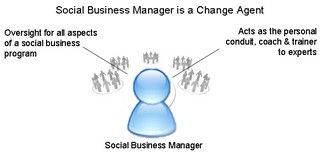
Social business management is undertaken by people who create and engage in social digital experiences on behalf of your brand. At IBM, there’s a new role emerging, the Social Business Manager. This individual not only collaborates closely with the extended marketing management team to provide oversight for all aspects of a social business program including social listening research, planning, engagement and measurement. They also act as a change agent.

They’re driving cultural change and adoption of social through their commitment to:

  • Work with employees as a relationship manager and coach
  • Provide direction to employees on relevant influencers, external brand champions, partners and competitors within specific topic area. Help employees establish priorities which relationships to focus on.
  • Provide supporting assets, program guidance, training and critical feedback to those employees engaged in social outreach

Through some early pilot work I’ve been leading, we’re able to quantify that engagement with influential experts in social media is 135%* more effective at generating sales leads than traditional digital marketing tactics. Another way of saying this is, trusted SMEs who share their expertise online are 7x more likely to drive initiations with a call to action (offer) when compared to other digital marketing tactics in the same period.

This is a win-win for the brand and employees. The employees benefit from building their professional reputation and increasing their visibility in their field, while they drive the brand’s influence and support lead development in the market.

If you’re approach social as just another channel for marketers to manage and push content through, think again.

*IBM Select Social Eminence pilot 3Q2012


SocialMedia in the Underground World of B2B

I just returned from SXSW Interactive, it was my first experience attending this event and I was thrilled be a part of it. If you’ve heard from others that it has to be experienced to be understood, it’s true – I’ve never seen anything like it. There was an incredible vibe from the massive amount of high energy innovators who are all on a quest to lead the future of digital & social innovation. Representation ran the gamete from small start-ups to well established global brands leading the way and shaping this exciting period of our history.

I had the privilege to represent IBM Social Business leadership by participating in a panel: SocialMedia in the Underground World of B2B  #SMB2B  in which we discussed many of the pressing issues of implementing social media programs and leveraging social media as a competitive advantage from a leading B2B brand perspective.

Melissa Chanslor from Text 100 Moderated the panel. Participating along with me were marketing leaders Duane Schulz – Xerox, Jeanette Gibson – Cisco and Shanee Ben-Zur – NVIDIA.

Left to right: Melissa Chanslor, Shanee Ben-Zur, Jeanette Gibson, Duane Schultz and Susan Emerick – Photo courtesy of Text 100

Here’s a summary of key points I shared based on our IBM Social Business leadership initiatives:

– Conduct social listening research to better understand how and where your constituencies are participating in social and apply insights gathered from the research to your marketing planning process and tactical execution roadmap.

– Deploy subject matter experts (SMEs) to build relationships with key influencers and those that follow them based on your understanding of the social ecosystem. This approach will position limited, high value resources strategically to drive business outcomes.

– Support SMEs to build their personal as well as your brand’s reputation by implementing employee enablement programs that support high value thought leaders to engage in the right place, at the right time in a secure way. Set clear priorities for engagement.

– Help SMEs understand the many benefits of committing to sustaining engagement by sharing examples of other leaders like them who’ve successfully established a position of authority as a trusted topical thought leader.

You can listen to the panel on the podcast on demand to hear the honest dialogue and many great recommendations shared amongst the team. Thanks to Constantin Basturea you can also read a summary of the Twitter steam on Storify


Thoughts on establishing a branded blog

Working for a Global Brand can bring questions and challenges for employees when it comes to whether or not they should establish a branded blog in their respective region or country. I recently worked on this guidance and thought it would be helpful to share with other B2B marketers who are working to establish branded blog guidance for their employees.

Online collaboration platforms — such as blogs — are fundamentally changing the way people work and engage with one another, clients, partners and prospects. By blogging, your ideas and expertise can be shared enabling dialogue with clients, shareholders, and individuals in the country in which you market. Blogs can be an important part of your country’s overall communication strategy, however as you consider getting started, it is critical that you begin with an understanding of the worldwide strategy for your program, brand or service, and determine how to support that strategy before establishing your own country or regional branded blog.

Whether you integrate with an existing branded blog or create your own because one does not already exist, remember that you represent your company and must uphold the standards of quality pertaining to content, creation and curation, relationship management, real-time listening and engagement. Individuals are responsible for the content they publish online, whether in a blog, on a social network, or any other forms of user-generated media, so it is imperative that you provide social computing guidelines for employees to follow. As an example, here’s a link to IBM’s IBM social computing guidelines. Also, be sure to provide employees guidance to follow on any branding, naming and messaging guidelines that have been established.

Avoid Redundancy

A key aspect of a successful brand strategy is to provide value to social outreach and relationship building. Think about how you can centralize efforts to increase reach and impact rather than running the risk of duplication and redundancy which could be the result of working independently.  Begin by taking an inventory of what already exists and work to collaborate as a contributing guest blogger as opposed to creating a new blog. Group blogs are encouraged and often overlooked as a strategic option.

Make A Plan

Establish the editorial calendar, messaging and subject matter experts to contribute content that will ensure the blog will provide value to the target audience, be a long-term, sustainable presence that fosters two-way dialogue.
Should I set up a blog?
Before getting started consider the following: Does a branded blog already exist that offers the same type of content and reaching the same constituents as you would like to? If so, then you should work with the blog author to contribute as a guest rather than establishing a separate and potentially redundant branded blog.
What are your objectives?
If no branded blog exists, you should clearly define the objectives for your blog before you establish one. Consider what role you expect the branded blog to play. The more specific your goals — defined over a timeframe — the easier it will be to focus your efforts.
Who is your audience?
As you begin planning a branded blog, it’s important to do so with a focus on customer relevance.

  • Whom are you trying to reach?
  • What knowledge are they seeking?
  • What problems or issues are they challenged with?
  • Are they consuming social media — and if so, what are their venue preferences?

Looking at a combination of these factors will help you ascertain the value of your blog and will help you evaluate if there is a place for a branded blog within your overall strategy.
Next, you should identify the needs of your target audience.

  • What are their goals and objectives?
  • What other blogs are they reading and why?
  • How will your blog be different from other industry-leading blogs?
  • What topics do they find of interest?
  • What are their pain points?
  • How will your branded blog provide them solutions?

Do you have the necessary resources to effectively manage a blog?
Before establishing a branded blog, you should be committed to maintaining a long-term, ongoing presence. This is not broadcasting, but relationship building. For this reason you should write in the first person — you are communicating to other readers in a one-on-one fashion and creating a relationship. You’re not simply delivering news, you’re delivering information and content through the lens of your experience and expertise. You’re delivering it in such a manner that others will find it useful or helpful. You’re adding value to the industry news by applying your observations or your perspective.

  • Are you committed to engaging in a conversation?
  • Will it be supported by you alone or by a team of owners?
  • Are your authors skilled in first-person blog-writing style?

You should plan enough time to author new posts regularly, listen to your followers and respond in a timely fashion to comments they share on your blog, and expand your network. You will want to post at least two times a week, with an ideal post length of around 500 words.

  • Are you able to effectively manage and maintain valuable content and grow and nurture relationships? Keep in mind that readers will post at all times of the day and night — and may expect responses within a business day.

Will you have a person dedicated to responding to your audience, or will you do it “in your spare time”? Be realistic about the amount of time you can spend on this work.

What criteria will determine the success of the blog?
Key performance indicators (KPIs) can be used to gauge the success of your branded blog. The challenge is knowing which measures are meaningful. Some important criteria to track would be Reach, Engagement and Advocacy. A monthly review of your success metrics and your goals will help you keep track of your progress.

Understanding policies:

  1. Ensure that your branded blog complies with your companies Social Computing Guidelines. This includes all entries within your blog, whether you author them or not.
  2. Remove any community-generated content that violates your companies policy and if, necessary, report any violations.
  3. Follow any processes established for starting blogs, reporting defects, requesting technical support or submitting requirements.
  4. Respect copyright, fair use and financial disclosure laws.
  5. Follow messaging and naming guidance.
  6. Protect all confidential and proprietary information.
  7. Don’t cite or reference clients, partners or suppliers without their approval.
  8. Know the rules for engagement: what is appropriate to share and what is not.
  9. Identify yourself. Names of the administrators must be publicly listed in the “about” section.

Maintaining your blog
Successful blogs have an editorial plan with a publishing cadence and are relevant to a topic that the target audience finds interesting and of value. Blog owners should establish an editorial calendar to help plan at least two to three posts a week. Offer content that aligns with the interests of your target constituency, is thought-provoking and timely. Here are a few examples:

  • Thought-leadership pointsofview (POVs) around industry hot topics or products.
  • Commentary on industry trends and forecasts.
  • POVs on other blog posts.
  • Responses to common questions.
  • Review of industry-related news from reputable third-party resources.
  • Information such as company press releases for new products.
  • Identification of current events and how products and/or a virtualized environment could have played a role in preventing, improving or evolving the situation. These types of posts are dependent on outside circumstances but allow readers to apply the benefits of technology to issues and situations that resonate with them.
  • Pre- and post-events coverage: Before and after events, write posts detailing your attendance/participation and link to other industry influencers who are either planning on attending or did attend. Following the event, write a recap and link to any Influencers you may have met or listened to while in attendance. For example: A post could revolve around “Five Things I Learned at Event XYZ.”

Promoting your blog
Once you have set up a branded blog, you should consider how you will promote it and attract a following. To ensure that your content has the highest potential to be viewed by new audiences, there are a number of tactics that can be utilized. Here are some starting suggestions:

  1. Build a strong blogroll— a blogroll is a list of blogs that you might recommend or link to on your blog in a sidebar list. Your blogroll should contain influencers and peers.
  2. Comment on — and link to — influencer blogs and blogs in your blogroll frequently. The best way to generate awareness around yourself (or the team) as a thought-leader and the content you post to your blog is to actively participate in conversations and comment on other bloggers posts of interest. By exposing yourself to industry influencers, you have the ability to initiate a discussion and share your point of view by leaving a comment and linking back to your blog.
  3. Use the same keywords you use in your blog posts when writing your comments, as this information is searchable and can increase search results.
  4. Be sure to include your name and a link to your blog in open fields or at the close of your comment.
  5. Link to interesting/valuable content posted on relevant blogs
  6. Share links to posts on other social media properties for example: LinkedIn Status Updates, Twitter, etc.
  7. Ask your readers for feedback or future topics they’d like covered or where you can provide additional details and information; pose questions to audience or bloggers as part of your post.
  8. Reach out to fellow bloggers for guest post opportunities on your blog and on theirs
  9. Approach other bloggers or team members, who don’t necessarily have their own blogs but would like to contribute, and encourage them to build their social eminence by authoring a guest article for your blog. Also, consider co-authoring posts.
  10. Include a link to your blog in all social profiles and in your email signature(s).
  11. Enhance search results by using consistent keywords in the metadata (tags/categories) that resonate with your target audience – be sure to use their language. Consistency of key terms will be indexed by search engines — impacting organic search results.

Traits of Subject Matter Experts who are successfully sharing their knowledge and expertise through social networking

Over the last few years I’ve been working with colleagues across my company to provide them guidance on becoming more effective with sharing their domain knowledge through social networking and collaboration. Many Subject Matter Experts (SMEs) I’ve worked with often ask me “What characteristics are common amongst those that are the most effective and influential?”  The following is a collection of my observations as well as some suggestions from my work enabling the social workforce.

Be true to yourself

Always be true to yourself when you engage in social activities. When establishing a social presence it should be an expression of who you are and what you want to share with others about what you know. Consistently present yourself, using the same tone, in every interaction and communication. Know yourself and be authentic. Be Genuine. Be Real. Be yourself – only you can do that!

Putting yourself out there

I find that the SMEs who become known are those that are comfortable collaborating, commenting, and publishing in social environments in a sustained and highly engaged way. You should assess your comfort level with establishing a public persona. By nature, being active on social means you are putting yourself out in public. When doing so, being honest about who you are and what you know is critical. You need to be comfortable and have a willingness to share your name, your thoughts, opinions, and recommendations to help others who seek your domain expertise. Doing so will help build your character and establish credibility. As you think this through, know your limitations. If you are not comfortable with sharing your knowledge and expertise in such a public forum, you should recognize and respect that.

What are your goals? What do you want to accomplish?

Are you looking to monitor competitors, connect more closely with your customers, or to establish yourself as a prominent thought leader in a particular area? Think about your goals and what you want to accomplish before you get started. Establishing goals will help you to be true to yourself, know your limitations or obstacles as well as provide you context for which tools and venues you should consider as best fit to match your intentions.

Know your audience

Successful SMEs listen to their audience and are willing to leverage listening tools to gather social intelligence and identify the existing social graphs of those they most want to connect with. Consider enhancing your online professional network by:

–       Studying your target audiences wants and needs

–       What questions are they most commonly asking?

–       What issues/problems are they looking to solve?

–       Understand the knowledge sought – do you have something of value to offer? Knowing what is happening TODAY in product or technology vertical is critical

Gather social intelligence to better understand the social ecosystem

–       Pay attention to where they most often participating on-line

–       Which venues? Which communities? Which forums?

–       Who are they connected to?

–       Who are they influenced by?

–       Are you connected with them? If not, why not? Perhaps you should be

Know the rules for engagement

If you are sharing your professional knowledge about a brand or product, you should be sure that you understand the way that topic, brand or product should be represented.

– How should the technology, product or brand be referenced?

– Understand the messaging

– Understand the keywords and natural language your audience uses to discuss the topic, brand or product

– Understand what is OK or NOT OK to share

– What digital assets are available for you to share which would help you help your audience further understand?

Only the passionate survive!

Those that have deep subject matter expertise to share and are passionate believers that knowledge they possess is of interest and will benefit the community they intend to share it with, are the most successful at building a degree of influence. They are relationship builders at heart, who are comfortable with and find value in creating relationships digitally. Successful SMEs are on a quest to make connections and deepen relationships with those who are seeking and understanding of the topic that they are passionate about.

Commitment to sustained engagement

A key trait of successful SMEs is commitment. They strive to sustain engagement long term, while growing and evolving their participation over time to achieve personal and business objectives. They understand that it takes time to build credibility, trust and a degree of influence. They understand that it requires a long-term strategy.

Inquiring minds want to know

Curious by nature engaged SMEs don’t pretend to have all the answers. They know that ambiguity breads commentary and feedback. They often leave the last word to their audience. Doing so allows them to learn more about their audiences needs. It also provides them a way to be responsive to the topic/discussion in a more engaged and relevant way.

Karma

Successful SMEs understand the basic premise of cause and effect, what goes around comes around. They strive to serve the needs of others while receiving insights for themselves. They know that what they publish is permanent and can not be taken back. Remember, if you publish something inappropriate, embarrassing, or hurtful, there will be a record for years to come.


Do you have ideas to share on guiding and enabling SMEs? I’d love to hear them.