This isn’t Margaritaville. You can lose the parrot head, my friend.

What’s the most common Employee Advocacy mistake brands make? Many brands have given their employees permission to use social media, published a social media policy, and offered training on the use of social venues. But that level of support leaves a lot of potential value on the table.

Many brands avoid empowering their employees in social media because they do not want to dis-intermediate the marketing team from customers, or they do not want employees creating brand assets that the brand does not own. Some brands fear that employees in social media could damage brand reputation or violate regulations and create liability for the brand. Some brands just do not know how to begin.

Regardless of how a brand feels about its employees in social media, nearly every brand today has employees who are active in social media and employees who talk about their brand in social media. Those employees engage in social media for a wide range of reasons. In many cases, employees get into social media because their partners and customers demand it.

While almost every brand today can find employees using social media to discuss their products, services, working conditions, and so on, the brands that achieve the most value deploy corporate resources and guidance to empower their employees in social media.

Parrot HeadSimply asking employees to parrot brand-generated messages through their personal social media may help the brand to gain small amounts of reach or engagement, but it is not a sustainable strategy for engaging audiences and developing relationships online. It is easy to do, so a lot of brands do it; however, that approach fails to respect the relationships employees and their audiences, so it does nothing to help employees create a differentiated and effective presence online. Specifically, when people simply repeat brand-generated messages, they lose the ability to attract people like me, thereby diminishing their ability to build trust and advocacy online, or worse irritating their network and causing abandonment.

Here’s a hilarious example of the effect of parroting messaging featured by CONAN, to demonstrate the point:

See what I mean?

All joking aside, this kind of parroting can do huge damage to your brand. Not only is irritating your followers, it’s likely driving them away in droves.

A preliminary study that I’ve been working on, with my colleagues in IBM Research Watson Lab, has found that more than 50% of the 230,430 followers of a certain branded social account is also following more than one of the company’s branded or employees accounts. Given this, there is a risk of creating more spam than value for our constituents, if parroting messaging and distributing through multiple accounts continues. Resulting in the opposite of creating value.

My team has coined the phrase “Ecko Gecko” to describe the phenomenon. We’ve created guidance to help our employees understand what negative affects parroting messages has when they simply copy & paste the same message and share it across multiple accounts. There is significant risk in damaging brand reputation.

Leading brands monitor social media and use social media analytics to observe and evaluate the effectiveness of their employee’s who are engaged in social on behalf of their companies. It’s scary what you might find. Especially when it comes to the practice of copying & pasting the same message over and over then distributing via social accounts, both branded and employee accounts. Are you monitoring in this way?

There is an important opportunity here, a teaching moment. Don’t let it paralyze your efforts, use the insights to create new education and training to course correct. Share the findings from your analysis and provide clear, concrete incentives for behavior modification. If you share examples of what not to do, backed by quantifiable and substantiating evidence based on data which demonstrates the negative impact such actions have, such as:

  • driving “un-follows”
  • encouraging “opt-outs”
  • causing “removals from lists”, (just to name a few)

Who can argue or ignore that?

For more on how to “Help Your People Do Well”, read chapter 2 of The Most Powerful Brand on Earth.
Buyer Guide: Social Employee Advocacy Software

If you’re considering Employee Advocacy as a means to drive engagement in Social Media, you’ll need to develop a solid program and make informed choices about the software to support it. This report, published today by my co-author Chris Boudreaux has been well researched, and will save you lots of time.

Chris explores over 25 vendors providing technology options for Employee Advocacy programs, while categorizing the into 3 key use case areas:

  1. Employee Enablement
  2. Compliance Management
  3. Performance Measurement

It’s a MUST read http://socialmediagovernance.com/social-employee-advocacy-software-buying-guide/

3 reasons people struggle to measure the value of Employee Advocacy in social media

People tend to struggle with measuring the value of Employee Advocacy in social media for three reasons:

• First, there is the data. Tons of it. So much data that we call it big data. Social data aggregators and monitoring tools give us filters to remove much of the data that is irrelevant to a particular need, but even those tools often produce far more information than a person can digest.

• Second, there are the tools. Even after all the acquisitions that occurred during 2011–2012, there are still hundreds of social media measurement tools on the market. None of them will address all of any organization’s needs. In fact, many companies hire consultants to help choose the right bundle of measurement products, usually from multiple vendors.

• Third, people don’t know what to measure. Social media are still very new to most people. In addition, the media and our ability to measure them are still rapidly evolving. And many people simply measure whatever metrics the social networks publicly display, such as Fans or Followers.

So how to begin measuring the effectiveness of your brand and employee advocacy program?

You need a framework

At the most basic level, social media are all about relationships. Unfortunately, most measurement tools or approaches focus on interactions or transactions. Some tools focus on conversations, but that is still not the same as relationships. For example, Facebook “Likes” are not relationships. Brands that define their goals based on a targeted number of Likes are not focusing on relationships because that kind of goal focuses on one specific interaction or transaction. Such goals do not guide an organization to nurture valuable and lasting relationships with customers.

In general, the most successful employee advocacy programs provide fact-based, quantified performance feedback that encourages desired behaviors. The only way to do that is to establish a consistent measurement framework with clear metrics that everyone understands.

I see lot’s of attempts to pull together glitzy reports with loads of data but little insight or quantifiable attribution on how employees are actually contributing to business outcomes and demonstrating that their efforts are helping the brand gain share of wallet or increase it’s favorable position in the marketplace. If you’re stuck with this challenge, I recommend you begin by establishing a clear and consistent Measurement framework, with supporting key performance indicators (KPI’s) aligned to business or program goals.

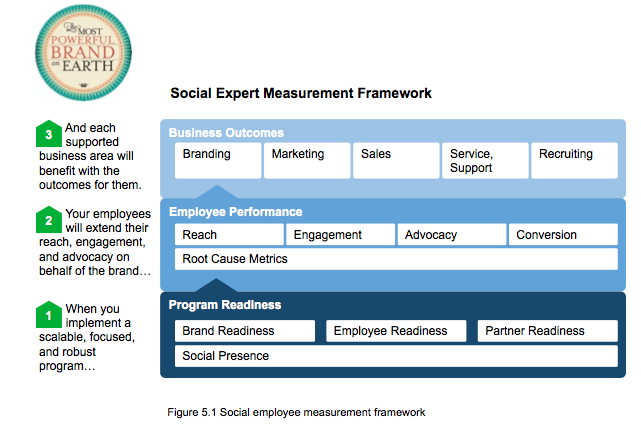
Here’s a basic construct we’ve been evolving over years. It can be applied to B2B and B2C industries. You’ll need to evaluate performance in 3 key areas:

• Program readiness: Continually appraise and assess the degree to which your internal capabilities are prepared to pursue and achieve the goals you set for your program or your team.

• Employee performance: Measure the performance of your employees* in social media.  For all of those groups, measuring their performance is not the same as measuring their activity. Therefore, your measurement efforts should focus on outcomes that your employees achieve with their target audiences, not the amount of work each employee does or how much content they produce.

• Business outcomes: All of this effort should be guided by your business priorities: the outcomes that matter for your organization. Maybe you want to find new customers. Maybe you want to hire the best people. Maybe you want to increase satisfaction among your existing customers. As you design your Employee Advocacy program, be sure to specify the business outcomes you seek to support and then define a plan to measure the extent to which you actually help achieve those outcomes.

Screen shot 2014-02-12 at 8.38.09 PM

Define a plan for measurement that includes the specific brand goals the program is intended to support, the tactics you will use, and the metrics you will track to evaluate success. Before you set out to measure and report performance on any one of these, you’ll need to set specific goal attainment targets from an established benchmark data, such as:

• Increase community engagement by your internal experts by 5 percent monthly from current baseline xNumber.

• Increase the online share of voice created by external influencers by 17 percent, versus your current baseline xNumber, by the end of the fiscal quarter.

• Increase employee connectivity to influencers and their extended network by 10 percent, from the current baseline xNumber, within the next 6 months.

The framework should ultimately allow you to measure and quantify to outcomes any effort (program, campaign or tactic) delivers. For example, financial impact but can be measured in terms of cost savings, quality improvement or increased revenue attainment.

See more details on these concepts and frameworks in The Most Powerful Brand on Earth – Chapter 5: You’ll measure new things in new ways

Also, I found these related posts on measurement by Ted Shelton and  Augie Ray to be insightful.

*The term “employees” can include employees, partners, and affiliates.

Embracing Brand Identity in the World of Social Media

Your employees are the stewards of your brand, empower them to share their expertise & knowledge in service of customers. This won’t just happen, cultural change & a system of engagement are necessary to make it a reality. Ethan McCarty shares what we’re doing at IBM to Embrace Brand Identity in the World of Social Media.

Want to find brand ambassadors? Start with your employees

CMO of Branderati and author of Think Like ZuckEKaterina Walter explores the emerging employee advocacy movement in this post: Want to find brand ambassadors? Start with your employees where she cites my point of view that “in social media people – not brands – are the channel.” For more on the importance of building trust & credibility, how to support your employees to engage and drive brand advocacy, and how not to treat social media as just another channel, reference:  The Most Powerful Brand on Earth

Work your core: Proven principals to drive Employee Advocacy results

This post provides a whole new meaning of “working your core”. These concepts will help you strengthen the results which your employees can drive by creating advocacy for your brand.

The target zone: Start small, be specific, choose wisely
Just like in a core body workout, seeing incremental results for the time and effort you put in, inspires you to keep with it. The same is true for building a employee* advocacy program for your brand. Start small, by choosing the best suited employees and partners, who will help you achieve and demonstrate incremental results more quickly. Be specific and choose wisely by applying the 1% rule (“90–9–1”) to your program recruiting. Focus on recruiting the best suited 1% of employees who have demonstrated they understand the value of building their reputation & are keen on increasing their visibility, committed to providing value to their network and sustain that commitment over time. Provided you’re conducting social listening, these select few are likely to naturally emerge in the social listening research as prominent and trusted experts in a topic that’s relevant to your business development goals. Use this intelligence wisely. Once you’ve prioritized this 1%, then set your sights on expanding to the 9%.

Consider establishing criteria which program participants must meet, here are a few examples I’ve found to be a winning recipe:

• A solid social footprint. Individuals that have worked to established a solid social footprint on their own and are focussed on participating actively in key social venues which are most relevant to the topic and/or network of interest.
• Accessible. Individuals who’ve proven to be natural collaborators and are comfortable with making themselves available to their network. They focus on responding & engaging in ways that provide value to their connections.
• Actions speak louder than words. Those that sustain engagement over time, are committed to sharing their expertise and helping others by demonstrating community leadership skills, drive superior results. They know well that it takes time, a commitment to consistency and engagement isn’t a hit-or-miss, occasional activity. They don’t just say they “get it”, they act on it. Engagement is a critical skill and is prioritized as an approach to the way they work.

Improve Reach: Focus on quality over quantity
At every stage of the customer experience, customers can talk about your brand within social media. As a result, you must nurture relationships in social media throughout the customer experience. Your employee advocates must be able to reach key target publics at each stage, get them engaged with your content, and motivate them to advocate on your behalf.

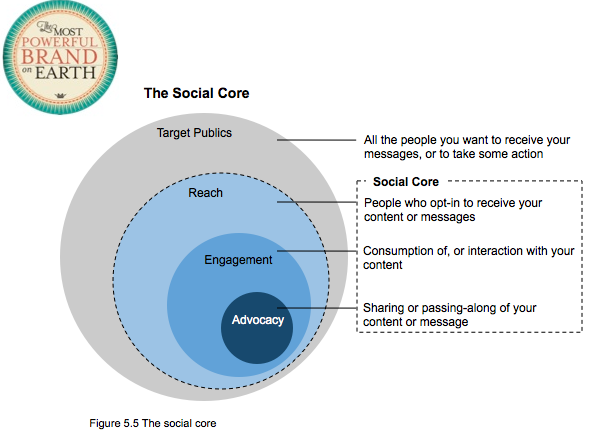
This is not easy to accomplish. It requires a focus, not just building a network for sheer volume, but rather building a quality network which shares common interest and benefits from the information your employees share. When your employee advocates nurture ongoing relationships with your audience in this way, they establish relationships with what we call a “social core”. The social core are simply people whom you reach, and have opted in to engage with you, and who would most likely advocate on your behalf.


Figure 5.5, The Social Core


Ultimately, the social core becomes an asset of the brand. An asset that you should mobilize your employees to nurture and build over time. In addition, you should continually evaluate and measure the health and strength of your social core so that you can continually improve the degree to which you are making it stronger.

See more details on these concepts and frameworks in The Most Powerful Brand on Earth – Chapter 5: You’ll measure new things in new ways


Embracing challenge. Pioneering brand marketers pave the way to lead digital & social business at their companies

Greg Gerik @ggerik of 3M moderates a panel of pioneering brand marketers at the 3M Think Tank. Kevin Hunt (General Mills), Susan Emerick (IBM) and Mason Nelder (Verizon) openly discuss core challenges companies face when embracing digital & social.

Mason Nelder @MasonNelder cites “Closing the leadership knowledge gap” as a huge challenge and how “It’s on us to communicate and educate” and help drive change.  “We’re in a big incubator – fail fast, fail often — but learn from it and find incremental gains.  … We must keep the voice of the customer at every point of the product lifecycle.”

Kevin Hunt @kevin_hunt explains the talent gap. “There aren’t enough rubber bands and sticks of gum”, currently staff is stretched really thin and lack of funding is a challenge. There’s an expectation that people will where many hats. In the future, it’ll be a luxury that we’ll be able to have staff who are more well rounded, demonstrating higher levels of aptitude to support your company’s needs. “There are scores of new leaders on the horizon, soon a new landscape will be upon us.”

What is Nirvana? Susan Emerick @sfemerick shares that “social must become integrated into the way we work, a part of every aspect of the work we do, and gone are the days of silo’s. Soon, it will be integrated into Sales, Customer Service, HR, in addition to Marketing & Communications. …. We have a vast opportunity to expose the expertise of employees through Employee Advocacy.”

Seated left to right: Kevin Hunt, Susan Emerick, Mason Nelder and Greg Gerik

Touring the 3M Innovation Center was an amazing immersive experience. The space, set up with interactive demo stations, chronicled thousands of product discoveries, advancements and featured how each makes life better. Burgeoning with stories about the work passionate 3M employees do, all just waiting to be told.

A huge Thank You to Greg Gerik @ggerik of 3M and his team for organizing and hosting such a great event. I was honored to be included.


Customers Trust Expert Social Employees more than any other source

Employee Advocacy is getting a lot of hype lately. So what’s the secret to empowering social employees to be engaged in social media to benefit your brand? Here’s a short video from today’s 3M Think TANK, hosted by Greg Gerik where following Brian Solis, I present a few concepts from our new book The Most Powerful Brand on Earth: How to Transform Teams, Empower Employees, Integrate Partners, and Mobilize Customers to Beat the Competition in Digital and Social Media 

3M ThinkTANK, September 26, 2013 – Susan Emerick

For the full roadmap on how to mobilize expert employees to advocate for your brand, check out the book on Amazon

Two Surprising Keys to Build Trust and Drive Sales Through Social Media

In a world where information continues to explode, people still trust people. In fact, research from Edelman and Nielsen continue to show that people are more likely to trust information from an organization’s employee or from someone they perceive to be like themselves, than from an organization’s official communicators, web site or sponsored content.

If your content marketing plans do not include some level of empowering employees to publish in social media, you may be missing a huge opportunity to build trust with your audience.

This post Two Surprising Keys to Build Trust and Drive Sales Through Social Media by my co-author Chris Boudreaux, ran today on Social Media Today and will help you understand how to build trust and drive sales in Social Media. 

How many hours of social media training are enough for social employees?

There is no right answer to this question. The number of hours of social media training required depends entirely on the individual, for two reasons:

  1. Each person comes into social media training with a different level of understanding, skill and practical application of social capabilities.
  2. Each person is unique in the way they learn, some requiring more time than others.

So saying any given number of hours is sufficient is the really the wrong question. The notion of setting the clock and saying everyone should be able to get this in a set amount of time is pretty dangerous concept. Let’s play this out a little further …

Early adopters of social who’ve built a significant presence and social currency on their own prior to the training, may need very little training. While those starting from scratch and/or have many doubts about the value of social to begin with (these are the ones who come kicking and screaming into the training), may need much more, that is … if you convince them to being trained in the first place.

When building a training curriculum start by teaching:

  1. The value of building trust and credibility online and how it can be used to engage with colleagues, partners and customers to establish or nurture relationships.
  2. Help your employees understand the shift in the way people seek and consume information. And, how the most sought after sources are actually credible and trustworthy experts in their field. The 2012 Edelman Trust Barometer is a great study showing this trend.
  3. Explain the way humans communicate has changed dramatically as a result of social capabilities, our world becoming increasingly more social every minute and earned media sources remain most credible, the Nielsen Global Trust in Advertising Survey provide more details.
  4. Help them to understand how their personal engagement can benefit them professionally, as well as benefiting the company or the customers they serve.
  5. Be clear about the level of effort and commitment required to develop an effective online presence.

One size fits all training in a set amount of time with certification is a recipe for disaster. As cited by Gallup Leadership research:

When leadership fails to focus on individuals’ strengths, the odds of an employee being engaged are a dismal 1 in 11, or 9%. But, when . . . leadership focuses on the strengths of its employees, the odds soar to almost 3 in 4, or 73%. When leaders focus on and invest in their employees’ strengths, the odds of each person being engaged goes up eightfold.

I recommend a training program include an assessment of the employee from which they can plot the course that’s right for them. Consider approaching the assessment and personalized planning through the following steps:

  • Inventory each participant’s social presence to understand the social venues they use and how they use them.
  • Understand each person’s motivation for getting involved and remaining engaged in social media.
  • Assess the employee’s preferred online behaviors to determine the employee’s comfort level with various methods of engaging online. For example, do they only read what other people publish? Do they comment on other people’s content? Or do they create content on their own?
  • Determine the most effective ways to mobilize each employee according to their strengths and preferences. Also determine how you will empower them to utilize their skills, preferences, and strengths.

A social employee training curriculum needs to begin with an overview of the benefits of participating, clearly defining the expectations, time commitment, training support provided and the milestones, goals or desired outcomes your expecting them to drive. For example, our program focuses on 3 key themes Go Social. Stay Safe. Be Smart.

  1. Go Social: Collaborating via social computing to pioneer intellectual capital and drive innovation that matters for clients and the world
  2. Stay Safe: Practicing secure computing – building trust by taking personal responsibility to secure IBM, our clients and colleagues
  3. Be Smart: Building and sharing insight and expertise, and exercising good judgment

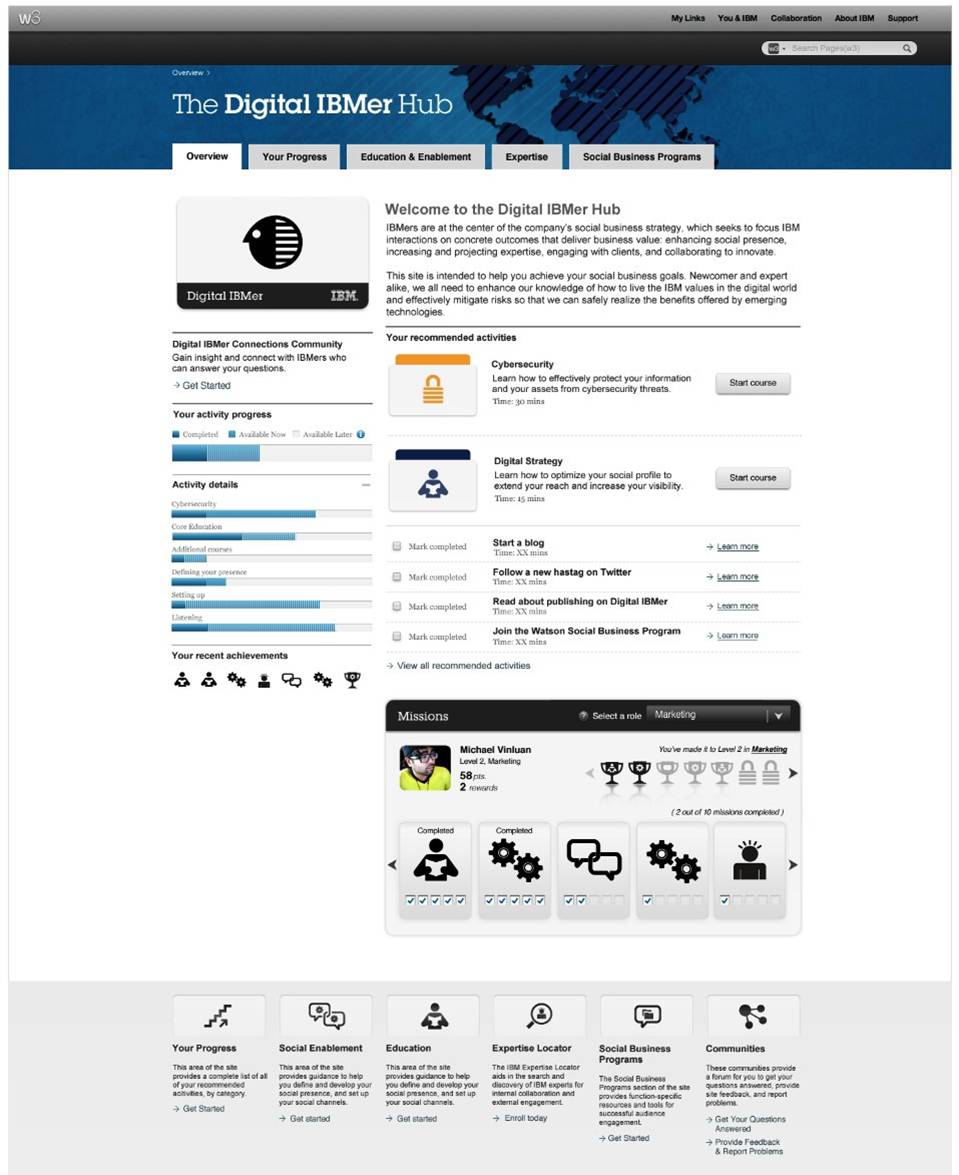
Digital IBMer Hub Overview Full Size

We’ve created over 60 courses available on the Digital IBMer Hub, IBM’s employee training portal, to educate our 430,00+ employees on Social Business best practices. Nearly 200,000 courses have been completed.

This is a tremendous opportunity for the employees, but they may not see it right away. If they don’t see the value for them personally and what they’ll get out of it any amount of time is a waste.


This post was inspired when I served on a panel today at the Social Media Today “Social Shake Up” event with Richard Margetic, Director, Global Social Media, Dell and Sandy Gibson, CEO, Elevate, our panel moderator was, Greg Shove, Founder and CEO SocialChorus. The panel was called “Throwing Open the Floodgates: Empowering Employees” – here’s a brief descriptor: The rise of social media means that employees can become engaged with their customers within their individual capacities. But of course that’s easier said than done. Well ask four important questions: What are the floodgates, what does through them open mean, what are the risks and rewards of dong so and finally, how do you best throw them open?

Our panel moderator, Greg Shove, asked us an interesting question …

“How many hours of social media training are enough for your employees before your brand considers ready to participate in social media?”

Richard, responded explaining the Dell Social Media and Communities University (SMaC U) program requires 8 hours of training before any employee can receive their certification and use the @Dell identifier an officially represent the brand.