Going #Rogue: Losing Control of Your Social Media

Social media plays an important role in global public relations strategies. As quickly as social media can build a global brand, it can tear one down at the hands of malicious insiders or hackers. Recently we have seen an increase in the proliferation of “rogue” social accounts across the social sphere. Attacks like these are not new. In 2013, hackers accessed both the Associated Press’ and FIFA World Cup’s Twitter accounts. A single tweet from the APTwitter handle resulted in a $136.5 billion drop in the S&P 500 index’s value in minutes. A year later Burger King’s Twitter account was made to look like McDonald’s while Jeep’s account was hacked noting that the company was sold to Cadillac.

Now, well known agencies like the Environmental Protection Agency (EPA), National Park Service (NPS) and National Aeronautics and Space Administration (NASA) have all fallen victim to “rouge” takeovers. Rand Research suggests that stolen Twitter accounts are now worth more than stolen credit cards. Rogue accounts attract followers by the thousands, which should be a warning signal for brands across the globe. Imagine losing control of your company’s online messaging or branding.

Crisis communication is evolving and becoming incredibly sophisticated. This session focuses on the variables involved in a new era of crisis planning and risk communication. Critical preparedness is important for the public and media when public perception becomes reality as a result of such a breach.

I was honored to present at PRSA 2017 International Conference in Boston, where I was joined by my esteemed academic collegues @GinaLuttrell  and @drjamiward
Screen Shot 2018-03-08 at 1.42.27 PM

In our session we shared: 

  • How companies can be proactive and vigilant when protecting their brand in an effort to mitigate ramifications from rogue sites. Discuss the ramifications associated with the public’s blind trust in anonymous communication.
  • The importance of investing in and equipping the workforce with training. How to train organizational leaders to react to a crisis including appropriate responses to the public and within social media. Plus, we examined the role that PR practitioners play in damage control should a “rogue” or “alt” channel become a reality for your organization.
  • Participants learned about the future of communication stemming from hackers or acts of civil disobedience.
  • We rounded out the session with outlining the difference between social media guidelines and policies, and how to begin building the framework for social media policies. Plus, writing social media policies and developing education and compliance training on cybersecurity will help to address vulnerabilities.

Are You Prepared?
Have You Prepared Your Employees?
Registered PRSA members can access our presentation here  If you’re interested in learning more about equipping your team, don’t hesitate to reach out to us!

Susan Emerick, Founder, Brands Rising

Regina Luttrell, Ph.D., Assistant Professor, Syracuse University, S.I. Newhouse School of Public Communications

Jamie Ward, Ph.D., Assistant Professor, Eastern Michigan University

3 Tips for measuring Employee Advocacy program engagement

So much goes into building and sustaining a successful employee advocacy program, yet one of the most commonly overlooked steps is determining how to evaluate and measure the varying degrees of engagement amongst program participants. Without a measurement framework, you will not be able to evaluate against transparent criteria and provide the appropriate level of reward and recognition based on the efforts each individual puts forth.

Here are 3 tips on establishing criteria for measuring Employee Advocacy program engagement: 

    1. Evaluate the degree to which they perform activities aligned with the Employee Advocacy Program’s goals
    2. Evaluate the degree to which employees are engaging in the content (commenting on it, linking to it from their user generated content i.e. blog posts) and the degree they’re sharing it with their networks
    3. Evaluate the degree to which employees demonstrate ongoing interest in being part of and advancing the program, this could demonstrated by consistently attending to program update calls, active participation in communities, providing peer-to-peer mentoring support to colleaguesFigure 5.11

For more guidance on measurement approaches and how to build out a mentoring program where employees who advance their commitment and adoption can become mentors of others to coach/train — reference Chapter 5 of The Most Powerful Brand on Earth.

Successful employee advocacy and empowerment begins with a plan

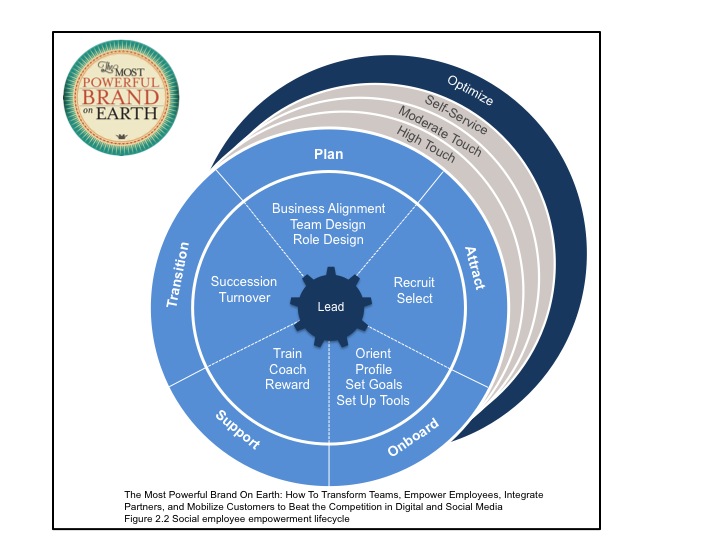
Successful employee empowerment begins with a plan, yet all to often critical planning stages are overlooked, and rushing to execution is the norm. The following 3 critical planning steps are an essential foundation for a successful employee advocacy program:

Build a plan that considers:
1. Business alignment
2. Team design
3. Role design

Figure 2.2

Let’s take a look at each of these in more detail

Business Alignment
In order to understand the current state of your employees in social media, ask the following questions:

• Which business topics will your employees discuss online?
• To what extent do your employees discuss topics related to your brand in social media?
• Do they have the expertise to discuss these topics in a knowledgeable manner?
• In which venues do they discuss those topics?
• Where do they participate most actively?
• Which target audiences engage in those conversations with employees?
• Do employees represent your brand, or only themselves, when discussing the topics that matter to your brand?
• To what extent do employees publish versus listen?
• Do they have a degree of authority among the people in their online community?
• To what extent do your competitors’ employees possess authority in the same online communities?
• How would you like the above factors to change?
• How much would it be worth to your brand to change the factors above?

Answering the above questions and creating an inventory of engaged employees helps you to understand what you need to do.

As you work to determine the organizational goals that your program will support, collaborate with the leaders of the business units or functional teams that the program supports. And help them to understand how your program can help them to achieve their goals. Then determine the order in which you will take the steps to implement social media empowerment for people in their organizations.

Specifically, you will not be able to deploy this program to the entire organization at once. Instead, prioritize internal teams for enablement, and manage expectations with their leaders. Ensure that everyone understands when you will be able to support their goals and empower their people in social media.

Team Design
Once you understand the organizational goals that you need to support, you can think about how you will organize your teams to achieve those goals.

For example:

  • Will you empower one person per subject area, or multiple people per subject area?
  • Will you empower people in one location, or across global regions?
  • How much time commitment can you expect from each participant?

This will depend largely on the extent to which their management supports their participation. To what extent will your organization’s marketing, PR, and brand staff participate in the program? Will they provide support, tools, or content to the people you empower?

Role Design
During this step, you will define the roles and domains of expertise that you wish to activate in social media. Your selection criteria should be based on your program requirements and the business outcomes you plan to support.

Employees must be segmented to determine which training, support, and tools they require and receive. Employee segmentation also determines the policies, rights, and privileges that apply to each employee. Some job roles may not be appropriate to activate or may require restrictions on their social media activity. For example, employees with access to the private data of your customers may need different tools than people with no such sensitive access.

See Chapter 6 of The Most Powerful Brand on Earth for more information about protecting the safety and security of employees, customers, and your organization.

Determine which roles in your organization are able to support brand outreach based on goals of your program and the extent to which each employee is expected or allowed to participate. Then, prioritize the segments of your employees and define the order in which you will empower each role type. For example, you might choose to empower product managers first, then product development staff, and market researchers last.

Finally, based on the information above, define the roles that socially empowered employees can play within your program. Specify how a role will be different when supporting marketing goals versus supporting recruiting goals. Perhaps they will use different tools, they may need different skills or experience, and they might set different goals for professional development.

For more detailed guidance, reference Chapter 2 of The Most Powerful Brand on Earth

Social Media Engagement forces HR to update job roles and skill requirements

The Human Resources department, in most organizations, is getting a dose of reality as they come to terms with employees having their own personal brand — forcing them to rethink job role definitions and skill requirements.

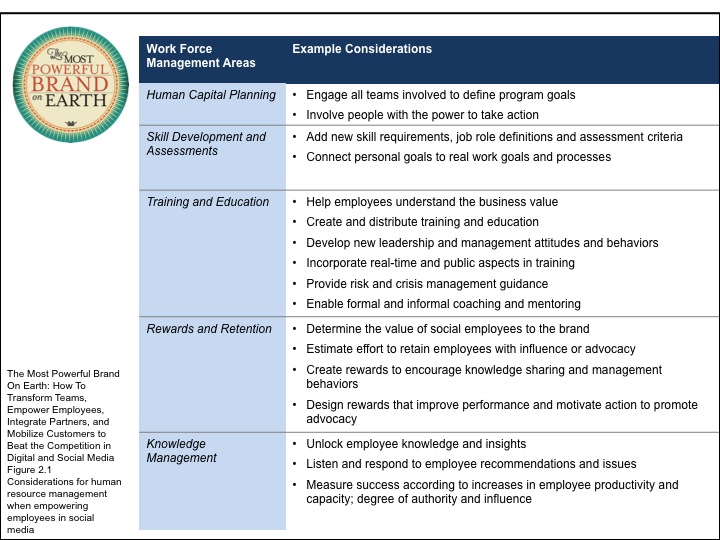
Long gone are the days that social media responsibility is limited to the social media team that administers branded channels or looks after social customer care. While these teams are still essential and have their critical role to play, employees are increasingly driving engagement with customers, partners and communities through social networking, requiring them to have the skills to engage in real-time conversations, online, and often in public view. But most are not professional communicators. So they will need new skills, and you will need to help them develop those skills while taking into account considerations based on various workforce management areas, as described in Figure 2.1. below
Figure 2.1

Scaling this kind of skills development program will require that you embed social media skills into the employee development and evaluation processes across the organization. Eventually, you will need to add social networking skills to your organizational skills taxonomy; in most organizations, this helps to define role standards throughout the organization.

Some employees’ job responsibilities will change, and the Human Resources organization will need to update job role definitions and skill requirements. These new skills will dictate employee performance evaluation criteria that may be new to the brand. You might find it helpful to define different skill levels at different career levels, and thereafter, skill development plans and assessments should change to support the new job role definitions, requirements, and career advancement.

During training and education, begin by helping your people to understand the business value that can be created when employees and partners build trust and advocacy online. To help them truly understand how the realtime and public aspects of social media engagement work, provide real-life examples that illustrate the types of behaviors you want them to demonstrate.

In particular, tell employees what they should do in social media, instead of what they should not do. Demonstrate this “what to do” approach across various roles in your organization, such as sales, marketing, and product specialists. Describe the benefits that the brand expects to achieve in terms of quantifiable business outcomes. Doing so will make the training more meaningful to employees.

Given the quickly evolving nature of social and digital media, you will need the ability to quickly create and distribute training or education to your people—especially as new channels, best practices, or policies emerge or fade.  This approach could easily be used to train employees who are active in social media and also to keep them continually equipped with the latest information about your brand.

Why You Should Embrace Helping Your Employees build their brand? (not to mention your company’s!)

Many brands avoid empowering their employees in social media because they do not want to dis-intermediate the marketing team from customers, or they do not want employees creating brand assets that the brand does not own. Some brands fear that employees in social media could damage brand reputation or violate regulations and create liability for the brand. Some brands just do not know how to begin.

Regardless of how a brand feels about its employees in social media, nearly every brand today has employees who are active in social media and employees who talk about their brand in social media. Those employees engage in social media for a wide range of reasons. In many cases, employees get into social media because their partners and customers demand it.

While almost every brand today can find employees using social media to discuss their products, services, working conditions, and so on, the brands that achieve the most value deploy corporate resources to empower their employees in social media.

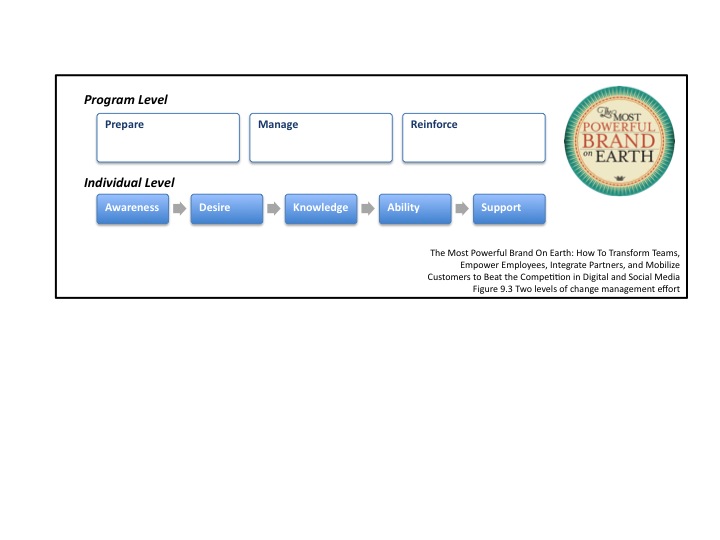
Simply asking employees to parrot brand-generated messages through their personal social media may help the brand to gain small amounts of reach or engagement, but it is not a sustainable strategy for engaging audiences and developing relationships online. It is easy to do, so a lot of brands do it; however, that approach fails to respect the relationships betwSlide3een employees and their audiences, so it does nothing to help employees create a differentiated and effective presence online. At the program level, design your training and support in 3 stages: Prepare, Manage and Reinforce. From an Individual level, program participants will advance along a continuium at their own rate and pace based on what they commit to. More details can be found in The Most Powerful Brand on Earth

In general, the greatest potential value of socially empowered employees can be achieved only when the brand aligns employee activities in social media with brand goals. And you should do so across the organization.

As stated by Danna Vetter, Vice President of Consumer Marketing Strategy at ARAMARK: “Each of our businessesthat are active on social has different strategies to meet their business needs. So the metrics we use to determine success vary by strategy. We expect employees to set goals and objectives to meet their business’ needs, just like they would in any marketing campaign. Our job is to give them the opportunity to be successful and provide them the tools that allow them to be.”

Brands that build the competitive advantages of socially engaged employees quickly encounter a host of internal and external challenges, including potential conflict between brand goals and the employees’ personal goals for their own professional reputations. Often, those two sets of goals may not align completely, and it takes some effort for the brand to keep it all working together.

The Smart Sceptic’s Guide to Social Media in Organisations

Colleagues, family and friends know I love to mentor, teach and guide, especially aspiring women leaders. Said another way, I love to encourage others to find and spark their “inner expert”. Helping them share their knowledge and thought leadership. I did this professionally for so many at IBM through the employee advocacy program I created called the IBM Select Social Eminence program, affording me the amazing opportunity to work with social business leaders across the globe. Also, I was lucky enough to have been inspired by Gini Rometty, CEO IBM. An amazing leader and the very first female CEO of the 100+ year old company, where I spent 18 of years of my career. Ginni taught me that ….

“In a social enterprise, your value is established not by how much knowledge you amass, but by how much knowledge you impart on others” ~ Ginni Rometty, CEO IBM 

You can read more about this in this post about the 10 Benefits of Social Business Collaboration

Meet Yekemi Otaru  

Yekemi Otaru, Author of The Smart Sceptic's Guide to Social Media in Organisations
Yekemi Otaru, Author of The Smart Sceptic’s Guide to Social Media in Organisations

I was fortunate to have the opportunity to become a protege to Yekemi Otaru several years back when she graciously reached out to me while researching and writing her masters thesis. Interested in tapping my expertise leading social business initiatives for IBM, a global enterprise with over 430,000 employees. The title of her thesis: Employee participation – the influence of enterprise learning during evolutionary change: a mixed method study into social media implementation (Distinction, 80%).

Right in my wheel house!

I’m proud to say that Yekemi has completed her Master of Business Administration (MBA, Distinction) Henley Business School and earned a distinction in Change management, Marketing in high tech industry.

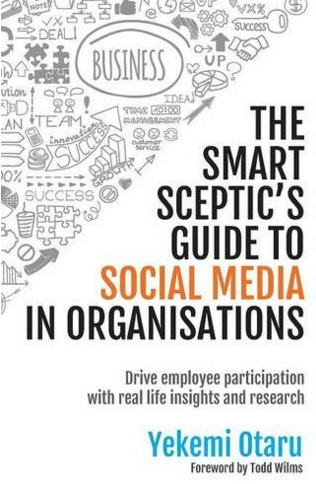
Well it doesn’t stop there! Yekemi, like me is always reaching higher. This month she did just that by becoming a published Author! The title of her first book is: The Smart Sceptic’s Guide to Social Media in Organisations 

Screen Shot 2016-01-31 at 2.13.42 PM

If you are considering employee advocacy for your organisation but you are not sure how to sustain the participation of your employees on social media, Yekemi’s book offers a three-step framework developed through research and real life examples.

Yekemi’s book is an interesting compliment to my book called The Most Powerful Brand on Earth. Both works help business leaders navigate with proven methods how to equip a social workforce. Further, customers trust expert social employees more than any other source.

While, Yekemi and I have never met in person (that would be a luxury I hope will happen some day!), we’ve collaborated by phone and across various social networks (LinkedIn, Twitter mainly) and across the Atlantic Ocean. Yes, This is the future of work!

Like me, Yekemi is a working Mother and business leader. She lives in Aberdeenshire, Scotland where she and her husband are raising their two beautiful children and striving for balance daily to make it all work in pursuit of her passions. She has worked in engineering and marketing roles at multinational companies such as Schlumberger and General Electric. Now an experienced strategy and marketing professional, Yekemi brings her unique reasoning and writing to tackle the challenge of social media, branding and the digital space in more conservative sectors such as oil and gas, medical, pharmaceuticals and manufacturing.

Connect with Yekemi – she blogs at thetaskmistress.me  follow her on Twitter @Mrstaskmistress  and buy a copy of her book on Amazon UK

Employee Advocacy: Program engagement doesn’t imply program success – part 2

As a follow up installment to my last post titled: Employee Advocacy: Program engagement doesn’t imply program success, I hope this follow up installment provides you considerations that will help you better understand why starting from the frame of reference of employees is critical.

Considering the vantage point of the employee, why is this so important?

  1. In order to truly encourage employees to engage in an employee advocacy program, you must start with defining and demonstrating how actively engaging in the program will help them increase their visibility amongst customers, influential decision makers, colleagues and industry influencers. Yes, that’s right, I also said demonstrate. That means you’ll need to develop case studies / real examples for employees to reference to help them get the picture.
  2. Start by designing education and support materials around common questions and objections employees have. If not answered from a benefit or position of value, employees will not adopt.
  3. When you design the program with these objections/questions in mind you’ll learn more about what employees are experiencing and you’ll be able to so when they’re raised we have a module/guide to address them in a playbook. This playbook becomes a helpful reference as you extend the number of program managers and participants. You can evolve it over time. Consider deploying a learning hub with a forum component that allows you to gather feedback and field questions. If employees are heard and secure support when they ask for help, they’ll increase their engagement.
  4. Be sure to educate them so they understand how engagement will help them work more effectively, efficiently and last but not least – – how they’ll get recognized for their efforts. It truly is a critical foundation that many brands miss when designing employee advocacy or social selling programs, often thinking that gamification or leader boards are all it takes to drive engagement. While these may help, I’ve learned that the most important and highly regarded form of recognition employees seek is visibility, you can read more about that in this post: What’s the #1 incentive employees seek from an Employee Advocacy program?

Screen Shot 2015-10-31 at 1.53.34 PMSo what are the most common questions employees may have? Here’s a few examples, that’ll help you get started:

  1. Why is engagement on social (for business/professional) something worth my time?
  2. Why me? Isn’t this kind of engagement for an intern who knows how to engage on social?
  3. Why should I focus my time on this when I have all these other pressing demands in my job role?

Which then leads into several other questions such as:

  1. How do you define “engagement”?
  2. What is expected of me?
  3. How will I be measured? Compensated?
  4. What are the guidelines?
  5. What training is provided?
  6. Will I be assessed for this?
  7. Is this mandatory?

The key here is to define the value proposition from the vantage point of the employee who will in the end be the lynchpin of the programs adoption and engagement success. The answers must be defined as benefit statements for the adoption and engagement … such as the benefits of:

        • How sharing and receiving knowledge helps them access to new ways of thinking, access to answers for challenges they’re grappling with and learning from someone who’s already figured it out
        • The benefits of being positioned as a thought leader, networking and relationship development, and how they’ll tap into the intellect of influential prominent thought leaders that are paving the way

The program foundation must include guidance for employees, a playbook that anyone in your company can tap for engagement guidance, it includes such topics as:

  • Policies
  • Procedures
  • Access to FAQs and directions for access to “go to contacts” for further help
  • Brand engagement guidelines
  • Safety and Security
  • Disclosure
  • Basic training portfolio

Consider tying adoption and engagement to the basic competencies for staff development and assessment. For example:

  1. Certification of completion is tied to learning/training objectives for all employees and is tied to skills development requirements, qualifications and assessment criteria used by HR and Management in the review, talent advancement and acquisition system.
  2. Focus on adoption and engagement for key segments of your employee population that will help achieve the highest priority business goals first, then expand from there.

sun-burstIt’s essential to have a core team that will actively manage the program and provide support to employees as they advance along the journey. If you need further guidance, reference the second chapter of my book: The Most Powerful Brand on Earth“Help you people do well” which explains how to establish a program framework which provides the foundation for your people to create and nurture relationships that drive engagement and create business value. Specifically, you’ll better understand how to plan the roles and skills needed, then attract, onboard, support, and measure the people whom you empower in social media.


Employee Advocacy: Program engagement doesn’t imply program success – part 1

I’m asked repeatedly, “What’s the secret to driving employee engagement for employee advocacy programs?”

The reality is, there is no secret recipe. In this post I’ll share a few thoughts which I hope aide you in evaluating the design of your Employee Advocacy program and help you make the necessary adjustments to drive more employee engagement.

To be sure we’re on the same page, let’s start with what I mean by “Engagement”. My starting premise is that the employee has already agreed to:

  1. Participate in the employee advocacy program
  2. Has been through the pre-requisite on-boarding, training and certification steps required to be officially granted program participant status. This means, they’ve been fully trained and equipped to engage across the social web, they understand the companies guidelines, policies, governance model.
  3. They know their role and how their engagement aligns to helping the company achieve specific goals.

If you need further guidance, reference the second chapter of my book: The Most Powerful Brand on Earth“Help you people do well” sun-burstwhich explains how to establish a program framework which provides the foundation for your people to create and nurture relationships that drive engagement and create business value. Specifically, you’ll better understand how to plan the roles and skills needed, then attract, onboard, support, and measure the people whom you empower in social media.


Program engagement doesn’t imply program success.

Employee engagement in the program is a means to an end. Constant, high engagement is a condition for a successful Employee Advocacy program, but it’s not enough.

Unfortunately, program engagement rates are sometimes considered as the most important key performance indicators (KPIs) for the program’s success. As a result, program managers are tempted to adopt tactics that will artificially boost engagement in the program. Stop right there! Increasing the amount of activity will not impact achievement of program’s goals such as driving an increase in lead generation or increased prominence and ability to influence to drive consideration, preference and choice of your brand’s offering.

To address this, make sure that you are clear on how your program defines program “success” standards:

    • Align the Employee Advocacy program’s goals with business objectives
    • Define the Employee Advocacy program’s success in terms of business impact (sales, conversion rates, cost savings)
    • Establish meaningful business KPIs for program’s success, which are trackable and quantifiable
    • Link performance assessment of Employee Advocacy program managers to achievement of program’s goals (aligned with business objectives), not to program engagement KPIs

The basis of the word “engagement” means commitment.  Approach engagement and adoption from the value to the employee in service of customers and your business will benefit. 

How to choose a Employee Advocacy software technology partner

Employee advocacy is becoming a mega trend. So much so, there are now over 30+ technology platform providers in the space within the last 2 years alone. If you’re considering evaluating employee advocacy software technology to support your employee advocacy program, this post is for you!

The most important first step has nothing to do with technology. 

Yes, really! First a foremost, you must establish clear business goals that your employee advocacy program is designed to support. If you don’t establish these and reach a unified agreement amongst company stakeholders on them, no technology platform can help you. Establishing clear and attainable goals is step #1. These goals must not only be clear and agreed upon, they must also be measurable! Otherwise you run the risk of not being able to evaluate program success by measuring performance and tracking progress over time. If you don’t sort this out first, your employee advocacy program will likely be short lived because you won’t be able to secure the needed investment and resources needed.

Once you’ve got your foundation of goals and how you will measure success in place, the 5 steps below provide you a proven roadmap. This isn’t simply my opinion. These are tested and proven. I followed these 5 steps with my team at IBM when we were evaluating and determining the optimal fit Employee Advocacy software platform for the global tech giant. I hope that they’re helpful to you:

  • Determine your business requirements for the technology before you begin evaluating any product, or requesting vendors bid on a Request for Proposal (RFP).  This sounds obvious, but I’ve learned from clients and colleagues who’re leading Employee Advocacy programs for their brands, this is often a step they missed. Work with your team and stakeholders to gather, catalog and prioritize business requirements that are “must haves” for a successful implementation of your Employee Advocacy program. Starting with business requirement will help you review platform options with the same criteria. Once you have this inventory, you can begin to prioritize the “must haves” against other functional features and sort through features that are “nice to have” but not critical your program.
  • Demo as many Employee Advocacy platforms as feasibly possible, a great way to do this is by attending conferences.  Be sure to take your “must have” criteria list and evaluate them first hand through demos and trials. In addition to evaluating the multitude of Employee Advocacy software platforms first hand, you’ll benefit from talking directly to the development and/or sales team.  This also allows you the opportunity to get to know the staff that you’ll likely be interacting with. You want to be respectful of their time. Remember that they’ll most likely need to help others who are at their booth wanting to see a demo. So if you think their offering may be on your short list, ask them if they would be willing to schedule a private demo while you’re at the event. This way you can run through your list of must have’s with their help and you won’t be feeling pressured by the line of others who are interested in accessing the demo and are vying for attention along with so many others waiting in line behind you.
  • Beware of the “Shiny object” syndrome. While you might see and learn about exciting new capabilities you never knew about during the demo phase, it’s critical not to forget that you and your team spent a great deal of time pulling together your requirements list, establishing the “must have” features for your employee advocacy program. Be sure you’re evaluating your options based on your program priority “must haves” and avoid running the risk of getting enamored with a bunch of shiny new technology functionality that looks cool but you may not ever use.
  • Be realistic about what you can afford! A saying my Dad used often was … “you have Champagne taste on a Beer budget” … Don’t let this happen to you while you’re evaluating employee advocacy platform options. You’ll need to secure financial support not only from your stakeholders, but also your procurement team. So be cautious of your limitations and evaluate options with the financial reality and any procurement limitations (i.e. the specifications for providers you can transact business with) in mind.
  • Form follows function This well-known architecture principal, originally defined by the great designer Louis H. Sullivan should be applied to the evaluation of Employee Advocacy software. Remember that the technology platform you select must be implemented within the business infrastructure your company has in place. Where “function” is the enterprise technology infrastructure, architecture, and business processes that any choice must integrate with, “form” is the Employee Advocacy software that will need to work within it. It is critical to follow the form follows function principal. Consider how your program operates within your business model and evaluate how the software will need to be integrated:
    • Will you require it to connect to your lead generation process?
    • Your Sales and/or the Customer Care operation at your company?
    • Your analytics, social/market intelligence and/or reporting functions?
    • Your CRM system?

Consider these system integration requirements up front. If you don’t, the business is likely to suffer from your choice down the road and be fraught with challenges to integrate with existing processes and systems costing you more even more money in the long run.

Do you have other steps you’ve found to be critical? If you have, I’d love to know what they were, please post a comment with your feedback.

Employee Advocacy Lead Generation: An “always on” marketing channel

Nearly all brands struggle to remain competitive and are seeking ways to do more with lower budgets.

Lower budgets along with the growing trend that people are more skeptical about messages and content that comes from official brand channels. So, what’s a marketer to do?

Sound familiar?

Enter your Employee Advocacy program


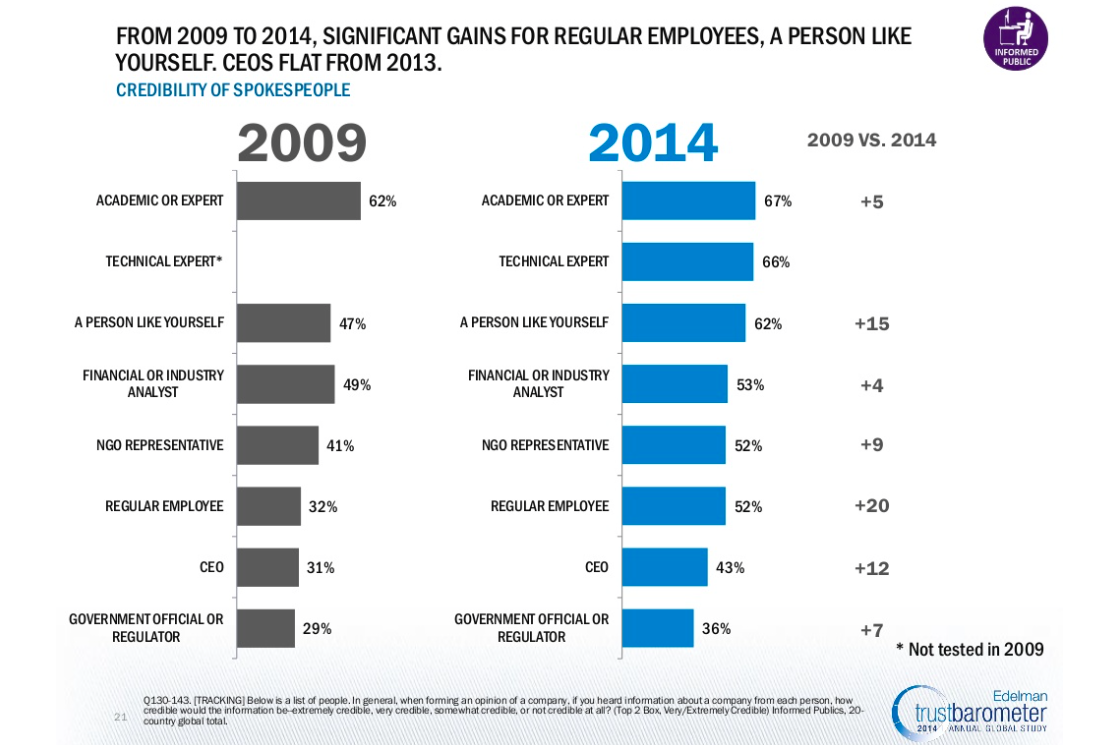
The good news is, people are more receptive to content that comes from a network connection. In fact, people trust regular employees as credible spokespeople more than official brand sources like the CEO, as shown by the 20 point gain since 2009, in 
Edleman’s 2014 Trust Barometer study. In addition, the study reveals that employees rank highest overall 36%, as the most trusted influencer to communicate across 4 out of 5 topic categories including: Engagement, Integrity, Products & Services and Operations.


Screen Shot 2014-07-29 at 12.00.23 PM


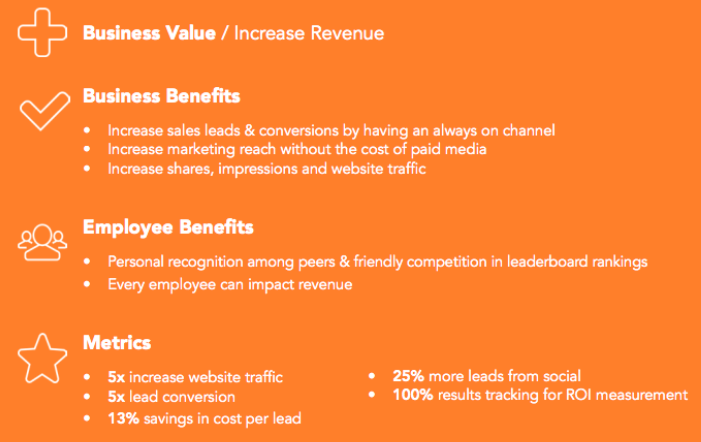
Because content from a connection is inherently more trustworthy or “valid”, it’s more likely to be opened, clicked, shared, and ultimately converted into a lead or sale. And since employees use social media around the clock, your Employee Advocacy program becomes an always-on lead generation channel.

Screen Shot 2015-04-25 at 7.14.06 PMLeading brands are increasing investment in digital marketing and Employee Advocacy programs that create business value through equipping and empowering employees.


The most common sources of value from such programs usually include increased revenues from employees who generate more leads and conversions to a call to action as compared to paid media.

Screen Shot 2015-04-25 at 5.10.14 PM

For more on this and other ways to drive business value from employee advocacy, download the eBook: Making the case for Employee Advocacy, 5 winning use cases that enable consensus and collaboration